

Solar Power Knowledge
Solar Panel Wholesale: Factory-Direct Pricing Tiers & Container Loading
 Gaotu Innovation
Summary / Article Summary
Wholesale solar panel pricing is not automatic volume discounting. This guide breaks down the four variables that actually determine landed cost: how price tiers are built around fixed-cost spreading, how many panels truly fit in a 40HQ depending on module dimensions and packing method, where lead time gets stuck and how to protect your schedule, and how bulk-order quality control differs from sample orders. It closes with Gaotu Innovation’s public numbers as a benchmark for wholesale buyers.
Quick Answers
- How are solar panel wholesale price tiers structured?
By how fixed costs get spread, not by raw quantity. Standard products run 10–20 panels, custom or OEM 50–100, full structural customization 100–200, and container MOQ 300–600 depending on wattage and size. The gap between tiers is roughly 8–15%—real money on large orders, but negative if you over-order inventory to reach the next tier. - How many solar panels fit in a 40HQ container?
It depends on module dimensions, packing method (palletized vs. loose), and loading orientation. The 2382×1134mm “golden size” achieves 98.5% loading efficiency, letting five pallet groups fit the 12m container length and stacked pallets clear the 2.69m door. Legacy 2278mm formats run about 94.5% efficiency—roughly 4.1% less power per container. - What is a realistic lead time for bulk solar panel orders?
Lead time is a range, not a number. It depends on production scheduling, cell supply, certification labeling, payment clearance, and vessel space. Confirm the production start date rather than just the shipment date, request weekly photo updates, book vessel space early in peak season, and build a two-week buffer into your schedule. - What quality control should a bulk order include?
Pre-production checks on cell supplier and grade, BOM sign-off, sample approval, EL images, and binning labels. Pre-shipment inspection with AQL sampling per ISO 2859, batch flash test reports, batch EL reports, and loading photos. IEC 61215 and IEC 61730 define performance and safety; ISO 2859 defines sampling—together they form the acceptance language. - How does Gaotu Innovation compare for wholesale buyers?
Gaotu Innovation has 18 years of OEM/ODM experience, a 35,800-square-meter Dongguan plant and an Indonesia manufacturing center, product lines from 7W to 550W, monthly capacity of 132,500 modules, 72-hour samples, and 18–25 days for mass production. Five overseas warehouses (US, EU, UK, Korea, Australia) support 2–5 day local delivery for distributors testing new markets.
The biggest mistake people make in solar panel wholesale is thinking “wholesale” means “buy more, pay less.” The reality: buying more only qualifies you to negotiate. It doesn’t automatically make the price better.
Moving from pallets to a full container, or from one container to multiple, crosses thresholds that each come with a completely different cost structure and negotiating logic. You take a 20-panel quote and ask for the 600-panel price, and the number they give you might look good—but the MOQ, lead time, payment terms, and even the cell grade behind that number may be things you know nothing about.
This isn’t going to feed you the “factory-direct lowest price” Kool-Aid. It breaks down the four variables that actually determine your landed cost in wholesale solar panels: how price tiers are built, how many panels actually fit in a container, where lead time gets stuck, and how quality control works for bulk orders. After reading, at least you’ll know which part of the number across the table is reasonable, and which part is a bet on you not knowing better.
Price tiers aren’t divided by “quantity”—they’re divided by how fixed costs get spread
Factories set MOQ and price tiers for two reasons: production efficiency and shipping efficiency. A partial container wastes space and complicates loading.
Standard-product MOQ typically runs 10–20 panels. At that volume, you’re almost certainly dealing with a trader or distributor pulling from stock, not a factory running a line for you. Custom or OEM orders jump to 50–100 panels, and full structural customization—different frame, junction box, cell layout—usually starts at 100–200. Container MOQ sits at 300–600 panels depending on wattage and size; that’s the point where ocean freight economics actually kick in.
Key insight: The gap between price tiers, across manufacturers and models, is roughly 8–15%. On a 10kW order, that’s a few hundred dollars. On a 100kW order, several thousand. Sounds meaningful—but if you push into the next tier by ordering inventory you can’t sell, those “savings” are negative.
What to ask: “Which tier does my quantity fall into? If I only change packaging and not the product, can it move up a tier? Are mixed wattage bins allowed in one container?”
How many panels fit in a 40HQ depends on three variables you probably haven’t calculated
This is where most first-time container buyers get burned. Panel count isn’t determined by “how big the container is.” It’s determined by module dimensions, packing method (palletized vs. loose), and loading orientation (vertical vs. horizontal).
Take the 2382×1134mm format. It’s called the “golden size” for a reason: the 1134mm width allows vertical stacking, with two stacked pallets reaching roughly 2.55m—just enough clearance under the 2.69m door height for forklift access. The 2382mm length, once packaged, lets exactly five pallet groups fit into the 12m container length with about 2cm of clearance—virtually zero wasted space. Compared to the previous 2278mm generation, loading efficiency rises from 94.5% to 98.5%, yielding roughly 4.1% more power per container.
What this means: If you’re comparing “price per watt” between two suppliers—one quoting 2278mm legacy dimensions, the other 2382mm—your landed cost math may be completely wrong. The freight-per-watt difference alone can eat the price advantage you thought you had.
What to ask: “For this model, how many fit in a 40HQ? Do you have a loading plan or loading photos? Palletized or loose?”
Lead time: 15 days and 35 days can both be legitimate—the question is which tier your order lands in
Bulk order lead time isn’t a number. It’s a range, and the most important information in that range is which tier your order falls into.
Factors that affect lead time: production scheduling (your position in the queue), cell supply (TOPCon availability fluctuates), certification (UL/CE labeling adds time), payment (production starts after deposit clears), and vessel space (tighter in peak season).
How to protect your timeline: Confirm the production start date, not just the shipment date. Ask for weekly production updates with photos. Book vessel space early in peak season. Build a two-week buffer into your project schedule.
Red flag: a supplier who says “15 days” under any configuration. Either they’re quoting stock-item lead time, or they haven’t factored in your customization.
Quality control for bulk orders runs on different logic than sample orders
One defective panel is annoying. A container of defective panels is a financial disaster. Bulk orders require a formal inspection process, not “we trust you.”
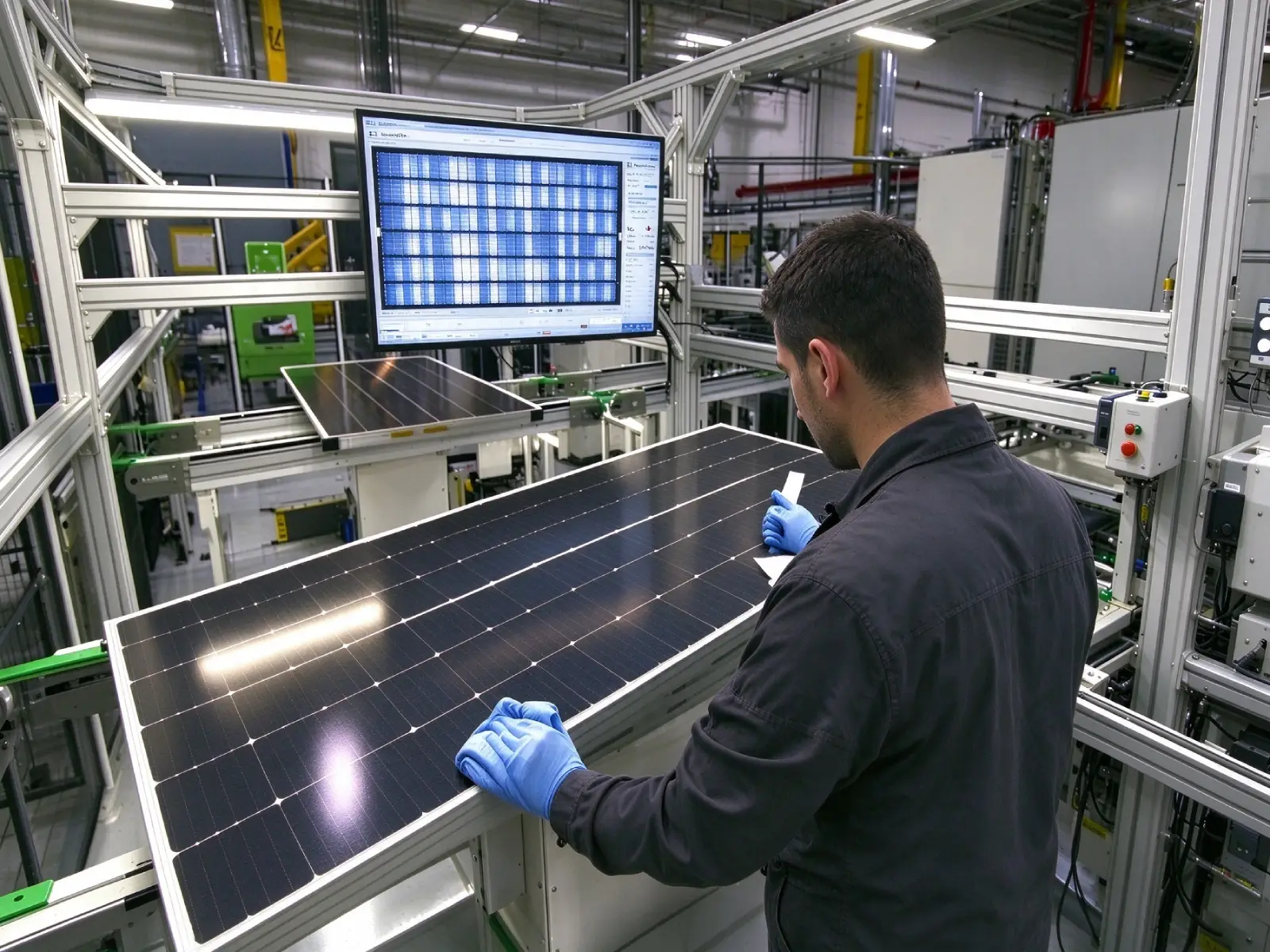
Pre-production checks: cell supplier and grade, BOM sign-off, sample panel approval, EL test images, power binning and labeling, junction box/frame/glass supplier confirmation.
Pre-shipment inspection: AQL sampling per ISO 2859, batch flash test report, batch EL report, packing and loading photos. IEC 61215 and IEC 61730 define module performance and safety requirements; ISO 2859 defines accepted sampling procedures. Those three documents are the shared language when you negotiate “acceptance criteria” with a factory.
What to ask: “What standard do you sample to before shipment? Are flash and EL reports batch-level or sample-level? Will you send loading photos for my approval before release?”
A reference point: where Gaotu Innovation sits in a wholesale context
If you’re running this framework against suppliers, Gaotu’s public information offers a comparison.
They’ve been doing OEM/ODM for 18 years, with a 35,800-square-meter main plant in Dongguan and a manufacturing center in Indonesia—primarily a tariff lane for the US market. Product lines cover portable foldable panels, flexible modules, and rigid panels, from 7W to 550W. Monthly capacity is 132,500 modules, samples in 72 hours, mass production in 18–25 days.
What’s worth noting for wholesale: they run five overseas warehouses (US, EU, UK, Korea, Australia), with local clearance putting stock in end users’ hands in 2–5 days. For distributors, that means you don’t have to push all your inventory onto the water at once—you can test a market with local stock first. OEM customization supports private labeling, spec and connector changes, and small trial orders.
One thing you’ll need to confirm yourself: their public wholesale page emphasizes “low-barrier OEM and fast delivery,” but doesn’t publish container-level price tiers or loading plans with the same clarity as their MOQ figures. If you’re going full-container, the loading and lead-time questions above still apply.
Contact: gtpowsolar.com, OEM and wholesale inquiries through the site form or info@gt-pow.com.
One last thing: in solar panel wholesale, the most expensive supplier isn’t the one with a high unit price. It’s the one who makes you think the unit price is low, then lets you lose the money back on loading, lead time, or quality control. After you get the quote, calculate landed cost first, ask for the loading plan second, and confirm inspection standards last. Get the order wrong, and every cent you saved comes with a price.
Related Posts

Wholesale Portable Solar Panel: The Ultimate Sourcing Guide for Bulk Buyers
Portable foldable solar panels have become one of the fastest-growing off-grid energy products globally. Demand…

Which type of solar panel is best for home use?
Installing home solar panels is one of the most practical ways to cut electricity bills…
Gaotu Smart Solar Outdoor Umbrella | Tap Into the Fast-Growing Outdoor Clean Energy Market
The outdoor sector booms with new opportunities; ordinary shade umbrellas lack distinction. Markets for backyard…

Leave a Reply