

Solar Power Knowledge
US Solar Tariffs 2026: Section 232, $0.38/W MIP & 15% Duty – Complete Sourcing Guide
 Gaotu Innovation
Article Summary
This guide explains the new Section 232 polysilicon tariff rules effective December 4, 2026, including the $0.38/W MIP minimum import price and 15% ad valorem duty. It clarifies common misconceptions around Southeast Asian origin exemptions, walks through cost calculations, lists excluded solar product categories, breaks down impacts for homeowners, installers and importers sourcing Wholesale solar panels, and provides a practical RFQ checklist for US solar sourcing.
Quick Answers
- Effective Date: December 4, 2026 (ruled by US customs entry date, not shipment or PO date)
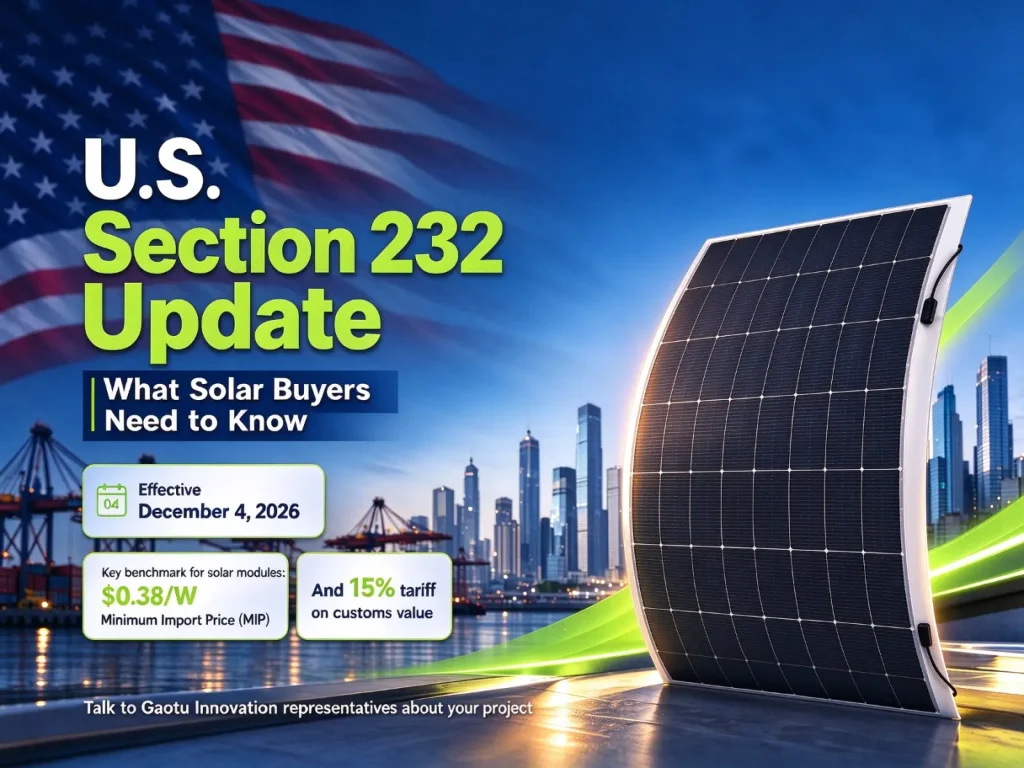
- Core Rules: $0.38/W MIP floor for modules + 15% import duty on covered crystalline silicon solar goods
- Myth: Production in Indonesia or Southeast Asia does not automatically avoid Section 232 tariffs
- Key Action: Calculate full landed cost and verify HTS code & origin documents before placing bulk orders
The new Section 232 polysilicon tariff rules take effect on December 4, 2026, bringing two core controls for covered solar products: a Minimum Import Price (MIP) floor and a 15% ad valorem import duty. Many buyers confuse the $0.38/W MIP with retail price or assume Southeast Asian manufacturing automatically avoids duties. This guide breaks down the rules, cost math, risk points and sourcing checklist for US solar distributors, installers, EPCs and importers.
Disclaimer: This content is for sourcing planning only. It does not replace legal advice, customs ruling or licensed customs broker consultation. Always confirm HTS classification and duty treatment with your customs team. We link the official Federal Register document for reference.
What Is The Section 232 Solar Tariff 2026?
Issued August 6, 2026, the presidential proclamation applies to polysilicon and its derivatives, including ingots, wafers, solar cells and solar modules. It is a global measure, not country-specific. Two mechanisms run at the same time:
- MIP (Minimum Import Price): the lowest acceptable customs declared value per watt for covered goods
- 15% ad valorem tariff: applied on the customs value of covered products, subject to MIP floor
Official MIP schedule for covered items:
| Product | Minimum Import Price (MIP) |
|---|---|
| Polysilicon | $21/kg |
| Silicon ingots & wafers | $100/kg |
| Solar cells | $0.22/W |
| Solar modules | $0.38/W |
Important trigger date: duty and MIP rules are based on date of entry into US customs, not PO date, production date or shipment date. Goods shipped before Dec 4 but cleared after Dec 4 fall under the new rules.
What The $0.38/W MIP and 15% Tariff Actually Mean (With Calculation Example)
A lot of buyers make a simple mistake: “just add 15% on top of $0.38/W”. It does not work that way. Logic:
- If your declared unit price < $0.38/W: customs will reset the declared value to $0.38/W, then calculate 15% duty on this floor value
- If your declared unit price > $0.38/W: MIP is not triggered; 15% duty is calculated on your actual declared value
Simple example (module):
Case A: Quote $0.35/W (below MIP)
Customs valuation = $0.38/W
Tariff = $0.38 × 15% = $0.057/W
Total customs base + duty = $0.437/W
Case B: Quote $0.42/W (above MIP)
Customs valuation = $0.42/W
Tariff = $0.42 × 15% = $0.063/W
Total customs base + duty = $0.483/W
Note: This only covers the 232 15% duty. AD/CVD, FEOC restrictions and other applicable duties may stack separately.
What Is NOT Covered Under Section 232 MIP & 15% Tariff?
Section 232 applies to polysilicon-derived crystalline solar cells and modules. Not every solar product is inside this scope. Coverage depends on HTS code, product construction and bill of materials. Products frequently reviewed for exclusion:
- Portable solar kits, flexible thin-film panels (non c-Si)
- Solar street lights, solar garden lights with integrated low-power panels
- Rack, mounting structure, inverters, batteries (standalone energy storage)
- Custom small solar assemblies where solar cell is a minor component
Rule of thumb: Product name does not decide duty status. HTS classification and BOM origin evidence do. If you are sourcing custom portable or off-grid solar products, teams at Gaotu Innovation routinely help buyers map out BOM and HTS details for pre-submission broker review before bulk production.
Impact By Stakeholder: Homeowner, Solar Installer & Distributor / Importer
For Homeowners
You will not see this tariff line item on your residential invoice directly. The impact shows up as shorter quote validity windows, higher deposit requirements and slower lead times from installers. Compare full turnkey system price instead of chasing the lowest panel watt price.
For Solar Installers & EPCs
- Lock quote validity periods clearly with suppliers
- Avoid last-minute module substitution: voltage, connector, listing and origin paperwork can delay permit and inspection
- Budget for landed cost volatility instead of only factory EXW price
- Review project timelines around Dec 4 entry schedule
For Distributors & US Solar Importers
This group carries the biggest risk: inventory exposure, origin documentation risk and margin compression.
- Do not stock blindly before confirming origin traceability files
- Pre-validate supplier’s ability to provide complete chain-of-custody documents
- Split sourcing strategy to balance cost, compliance and stock availability
Does Manufacturing in Indonesia / Southeast Asia Automatically Avoid Section 232 Tariffs?
Short answer: No. “Ship from Indonesia” ≠ Indonesian origin. Origin is determined by where the critical manufacturing steps happen (polysilicon, wafer, cell, assembly), not final packing location. A panel assembled in Indonesia using cells made elsewhere may still fall under Section 232 and MIP rules. Gaotu Innovation maintains dual production footprints to support compliance reviews for US-bound orders; still, no factory can guarantee tariff exemption. Every SKU needs separate HTS and origin review.
Full Landed Cost Breakdown for US Solar Import (Stop Judging by EXW Price Only)
Many RFQs fail because buyers only compare EXW factory price. Real landed cost includes many hidden items:
| Cost Component | Description |
|---|---|
| EXW / FOB factory value | Base product value |
| Ocean freight + insurance | Cargo transit cost |
| Section 232 duty | 15% duty (or MIP-adjusted base) |
| AD/CVD (if applicable) | Separate anti-dumping / countervailing duties |
| Customs broker & filing fee | Documentation, entry filing |
| Port drayage, terminal handling | Local port charges |
| Demurrage & detention risk | For delayed clearance / document mismatch |
| Compliance & traceability docs | Origin statement, BOM, test reports |
Landed cost = the true benchmark you should compare between suppliers.
Solar RFQ Checklist Before You Confirm US Orders
Before sending RFQ to any solar manufacturer for US market, collect these items:
- Exact HTS code for each SKU
- Full BOM: polysilicon, wafer, cell and module manufacturing location
- Expected port of entry to USA
- Incoterms (EXW / FOB / CIF / DDP)
- Estimated customs entry date
- Required certification: UL, ETL, fire listing
- Origin traceability package availability
- AD/CVD / FEOC compliance status
- Quote expiration term
- Volume, palletization and marking requirement
If you need a ready RFQ template for US solar imports, contact our solar sales team and we share our standard compliance checklist.
Stacking Rules: Section 232 + AD/CVD + FEOC – What Buyers Miss
Section 232 does not replace AD/CVD orders or FEOC restrictions. Duties can stack:
- AD/CVD anti-dumping duties apply separately based on origin history
- FEOC rules restrict eligibility for US tax credits and domestic content bonus
- A module may pass Section232 MIP review but still fail FEOC requirements, losing ITC bonus. When modelling project ROI, build all three layers into your cost model.
Frequently Asked Questions
Q1: When does the 232 solar tariff start? A: December 4, 2026. The key date is US customs entry date.
Q2: Is $0.38/W the price I pay to buy panels? A: No. $0.38/W is the minimum customs declared value (MIP), not wholesale or retail sales price.
Q3: Will all solar panels pay 15% duty? A: Only covered crystalline silicon modules, cells, wafers and polysilicon derivatives under HTS scope. Non-covered products are excluded. Confirm classification with a broker.
Q4: Can I lock old tariff rate by signing contract now? A: Contract signature alone does not grant exemption. Customs entry date governs treatment. Limited published exceptions apply; verify via Federal Register notice.
Q5: Can DDP shipping help me avoid tariff risk? A: DDP shifts duty payment to the seller, but classification and MIP risk still exist. Confirm supplier clearly defines duty responsibility and document package.
Final Takeaway
Section 232 changes the core of US solar sourcing: origin paperwork, HTS classification and landed cost modeling become as important as panel watt price.
For installers, the priority is stable quoting and compliant substitution. For distributors and importers, traceability and staged ordering reduce margin and inventory risk.
No supplier can give binding customs rulings, but a reliable manufacturer will provide transparent BOM, origin documents and support your customs pre-review.
If you are sourcing rigid modules, foldable solar kits or custom off-grid solar products for the US market, the engineering and compliance team at Gaotu Innovation can prepare full origin documentation packages to support your customs pre-assessment before bulk commitments.
Reach out to our solar team if you are sourcing modules, portable solar panels or solar systems for the US market. We provide full origin documentation support and help you evaluate landed cost before you place bulk orders.
Related Posts

RV Solar Panel Selection Guide: How to Pick the Right Panels for Your RV
Key Takeaways: Ultimate RV Solar Panel Buying Guide Picking RV solar panels isn’t just about…

GTPOW 820W Balcony Solar Kit: Drill-Free Home Solar Solution
Picture this: every morning, the sun rises over your balcony—and instead of just warming your…

Why choose flexible solar panels? What are its advantages?
Van life, cross-country road trips and off-grid camping have blown up in popularity these days.…
Share This Article
Latest Posts
 .38/W MIP & 15% Duty – Complete Sourcing Guide" decoding="async" loading="lazy" srcset="https://www.gtpowsolar.com/wp-content/uploads/2026/11/US-Solar-Tariffs-2026.webp 1600w, https://www.gtpowsolar.com/wp-content/uploads/2026/11/US-Solar-Tariffs-2026-300x225.webp 300w, https://www.gtpowsolar.com/wp-content/uploads/2026/11/US-Solar-Tariffs-2026-1024x768.webp 1024w, https://www.gtpowsolar.com/wp-content/uploads/2026/11/US-Solar-Tariffs-2026-768x576.webp 768w, https://www.gtpowsolar.com/wp-content/uploads/2026/11/US-Solar-Tariffs-2026-1536x1152.webp 1536w, https://www.gtpowsolar.com/wp-content/uploads/2026/11/US-Solar-Tariffs-2026-500x375.webp 500w" sizes="auto, (max-width: 1600px) 100vw, 1600px" />.38/W MIP & 15% Duty – Complete Sourcing Guide" decoding="async" loading="lazy" srcset="https://www.gtpowsolar.com/wp-content/uploads/2026/11/US-Solar-Tariffs-2026.webp 1600w, https://www.gtpowsolar.com/wp-content/uploads/2026/11/US-Solar-Tariffs-2026-300x225.webp 300w, https://www.gtpowsolar.com/wp-content/uploads/2026/11/US-Solar-Tariffs-2026-1024x768.webp 1024w, https://www.gtpowsolar.com/wp-content/uploads/2026/11/US-Solar-Tariffs-2026-768x576.webp 768w, https://www.gtpowsolar.com/wp-content/uploads/2026/11/US-Solar-Tariffs-2026-1536x1152.webp 1536w, https://www.gtpowsolar.com/wp-content/uploads/2026/11/US-Solar-Tariffs-2026-500x375.webp 500w" sizes="auto, (max-width: 1600px) 100vw, 1600px" />

Leave a Reply