

Solar Power Knowledge
How to Choose a Foldable/Portable Solar Panel OEM Factory: A Buyer’s Guide to Avoiding Pitfalls
 gaotu
gaotuI’ve been doing solar panel OEM for over a decade. And I get the same questions from buyers all the time: How do you know if a solar panel factory is the real deal? How do you check certifications without getting burned? Can MOQ actually be negotiated? What’s the real difference between white label and OEM?
Rather than explain it over and over, I figured I’d just write it down. Everything below comes from mistakes I’ve made or watched other people make. No theory. Just what actually works.
1. How to Tell If They’re a Real Factory
Don’t ask “Are you a factory?” Ask ten suppliers, and eleven will say yes. It tells you nothing.
Start by asking for their full registered company name.
Just say: Can you send me your business license with the full company name? A real factory’s sales rep will send it over in two minutes. If they start making excuses — “We mainly do export, the Chinese name doesn’t matter” — or only give you an English name, just move on.
Once you have the full name, look it up on China’s National Enterprise Credit Information Publicity System. Check two things: Is the registration still active, and does the business scope include “solar panel manufacturing” or “PV module production”? If it only says “wholesale, retail, trading,” it’s a trader, not a factory. I’m not saying you can’t work with traders. But you need to know who you’re actually dealing with. The pricing and quality control logic is completely different.
Then verify the registered address against the actual production address.
A lot of traders rent a desk in some industrial park or co-working space and pretend they have a big factory. Plug the address into Google Maps and look at the satellite view. If it’s an office building, a shared workspace, or an empty lot with no industrial facilities in sight, that’s a red flag.
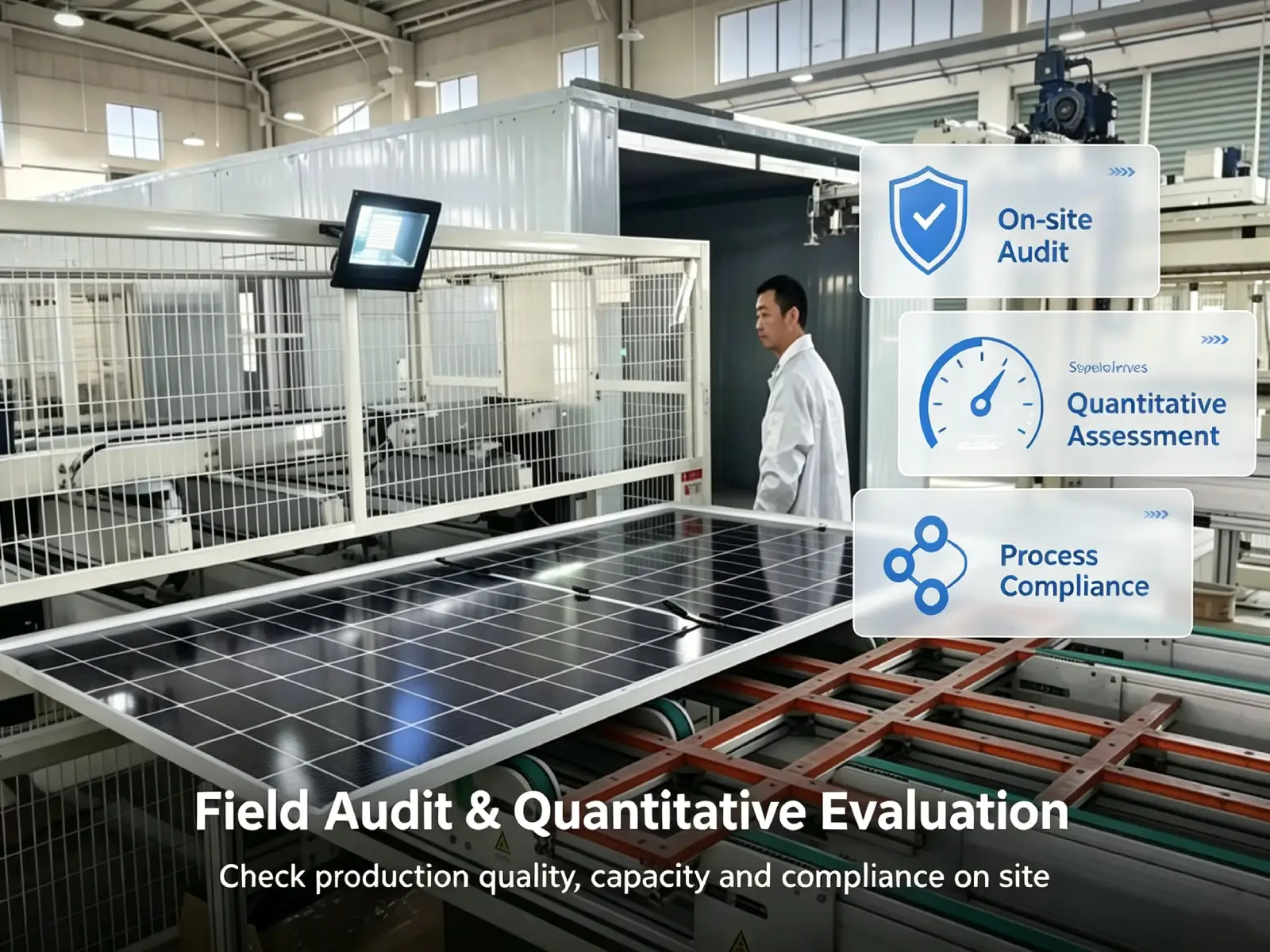
Even more direct: ask for a factory video. It doesn’t need to be professional. A phone clip works fine — just show the production line, the warehouse, the packing area. A real factory’s sales rep usually has one ready to go. If they stall, say “the workshop is on break today,” or promise to “have a colleague take one later” — they probably don’t have a workshop to film.
Finally, ask three numbers.
This is my own trick, and it works every time.
Don’t ask vague questions like “How’s the quality?” or “Is the frame sturdy?” Ask for three specific numbers:
-
What’s the wall thickness of the aluminum frame, in millimeters?
-
What’s the alloy grade? 6063-T5 or 6005-T5?
-
What’s the load rating? Wind load in PSF or Pa?
For the panel itself, the three questions are: Which cell manufacturer and what grade? Is the encapsulant EVA or POE? What are the actual measured Vmp and Imp — not the nameplate rating?
A supplier who can rattle off these numbers without hesitating is worth talking to. If they can’t answer, either they don’t know what they’re selling, or they don’t want you to know. Either way, the conversation’s over.
2. How to Read Certifications: Don’t Just Check “If They Have Them”
First, the types of certifications.
For portable and foldable solar panels, you can’t get around these:
-
IEC 61215 and IEC 61730 — the global baseline. The first covers design and performance, the second covers safety.
-
CE for the EU
-
UL or cTUVus for the US and Canada
-
UKCA for the UK — CE hasn’t worked there since 2021
-
TÜV is what a lot of German and European buyers look for
But here’s the biggest trap: having a certificate doesn’t mean the model you’re buying has one.
I’ve seen too many suppliers send over a stack of certificates that look impressive at first glance. Then you look closer — the model numbers don’t match, or it’s an old spec, or the certificate expired years ago.
Make them provide the certificate for the exact model you plan to buy. The certificate should show the product model, specifications, and expiry date. Don’t accept “our company has this certification.” The company having it doesn’t mean your model does.
And then — actually verify it.
Don’t just look at a PDF scan. TÜV, UL, and other certification bodies have online verification portals. Enter the certificate number, or search by company name. See if it’s real. See if it covers the product models you’re buying.
Fake certificates aren’t rare in this industry. I’ve seen people photoshop a company name onto someone else’s certificate. I’ve seen dates altered. Going straight to the certification body’s website is the only reliable way. Ten minutes of work can save you months of headaches.
3. How to Negotiate MOQ: Understand Why It Exists First
MOQ isn’t just a number the supplier made up.
A lot of buyers start with “What’s your MOQ?” and then immediately try to haggle — asking to cut 500 down to 50. That’s not the right approach. You need to understand where MOQ comes from:
-
Core components like solar cells and PCBs have their own minimum order quantities from upstream suppliers
-
Line changes, setup, first-article inspection — these all have fixed costs. Small orders just aren’t economical.
-
If new molds or custom housings are involved, tooling costs need to be spread across enough units
What’s typical in the industry?
For portable and foldable panels, it’s usually around 50 pieces. Flexible panels can go lower, around 10. If you’re just changing the logo or packaging and using an existing housing, MOQ is negotiable. If you need new molds or structural changes, expect MOQ to jump significantly — several hundred to over a thousand units.
If you want to lower MOQ, here are a few options:
-
Use existing housings and structures. Just do branding and labeling. Don’t touch the molds.
-
Accept mixed batches — multiple models sharing core modules, differentiated only by external parts.
-
Start with a paid sample or small trial run. Validate first, then scale up.
Ask about lead times at the same time.
Standard samples: 2 to 4 weeks. Mass production: 4 to 8 weeks. For custom OEM — new molds or firmware changes — add another 4 to 12 weeks. If certification testing is required, add weeks to months on top, depending on lab schedules.
When negotiating MOQ, always ask about sample fees and lead times together. These directly affect your cash flow and go-to-market timeline. Don’t just look at unit price.
4. White Label vs. OEM: What’s the Real Difference?
People use these terms interchangeably, but legally and operationally, they’re not the same thing.
White Label: You buy the supplier’s existing standard product. You change the logo, packaging, and labels. The product design, specs, and structure stay the same. The supplier holds the certifications. You sell it under your brand.
OEM: You’re involved in the design and spec definition. The supplier manufactures to your requirements. Appearance, dimensions, connectors, performance — all can be customized. Certifications are typically held by you, or jointly with the supplier.
Here’s the most overlooked — and most important — issue: liability.
Under white label, you are legally the “manufacturer” of record, not the supplier. If there’s a quality problem, a safety incident, or a recall, you’re the one facing end users and regulators. The supplier’s responsibility to you is supply and technical support. Your responsibility is product compliance and safety for the end user.
What does that mean? It means you can’t be hands-off. The contract needs to spell out quality standards, audit rights, and after-sales support terms. If the supplier discontinues the product or runs into trouble, your brand and customer relationships take the hit.
Make sure the contract covers these:
-
Product specs and acceptance criteria — in writing, not verbally
-
Who holds the certifications, who maintains them, and how recertification works if the product changes
-
Quality control — what’s inspected on incoming materials, during production, and before shipment
-
After-sales and liability — warranty period, what’s covered, how failures are handled, response times
-
Intellectual property — your brand and custom designs can’t be resold by the supplier to anyone else
-
Confidentiality — your specs, customer information, and pricing stay private
A Final Word
When choosing a supplier, don’t just look at the quote. Ask yourself three questions:
One: Can they answer the three numbers precisely? If not, eliminate them.
Two: Can they provide a valid certificate for the exact model you’re buying? If they only show company-level certificates with mismatched model numbers, be skeptical.
Three: Are they willing to let you test samples? A reliable supplier should be happy to send samples for evaluation — not push you to order based on a quote alone.
The cheapest supplier is often the one that ends up costing you the most. Portable solar panels involve electrical safety and outdoor reliability. One batch quality failure will cost you far more in after-sales than whatever you saved on the unit price.
There are no secrets in this business. It just comes down to whether you’re willing to spend the time asking the right questions.
About Gaotu Innovation
Gaotu Innovation (Shenzhen) New Energy Group. Our predecessor was founded in 2008, and we’ve been doing green energy OEM for 18 years. Two factories in Dongguan totaling 35,800 m², plus an 18,000 m² overseas plant in Indonesia. 380 patents. Product lines cover foldable, flexible, and tempered glass solar panels, along with energy storage, solar backpacks, and wearable solar gear. We’ve done foldable panel OEM and joint development for brands like ANKER, ECOFLOW, and BLUETTI. OEM, ODM, and small-batch trial production all supported.
Website: www.gtpowsolar.com
Email: info@gt-pow.com
Related Posts
How to Choose a Foldable/Portable Solar Panel OEM Factory: A Buyer's Guide to Avoiding Pitfalls
I’ve been doing solar panel OEM for over a decade. And I get the same…
Best Portable Solar Panels Wholesalers
Introduction As the global market for off-grid power, RV camping, outdoor energy storage, and emergency…
How to Choose & Install RV Solar Panels
1. How to Pick the Right Power Size for Your RV Solar Panel How to…

Leave a Reply