

Solar Power Knowledge
ETFE vs. PET Flexible Solar Panels: Which is Better for Commercial Sourcing?
 gaotu
gaotuFor B2B buyers, distributors, and product managers sourcing from overseas, evaluating price versus longevity is the ultimate balancing act. In the flexible solar market, this decision invariably boils down to one fundamental material question: Should you source ETFE or PET flexible solar panels?
At first glance, these panels look remarkably similar, but their operational lifespans and performance under extreme conditions couldn’t be more different. Sourcing the wrong material can ruin your brand’s reputation with high return rates.
Before signing your next procurement contract with a China flexible solar panel supplier, let’s dive into the technical data and UV lab testing results to see why surface chemistry dictates your long-term ROI.
1. What are PET and ETFE?
To understand their performance, we must look at their chemical compositions:
PET (Polyethylene Terephthalate)
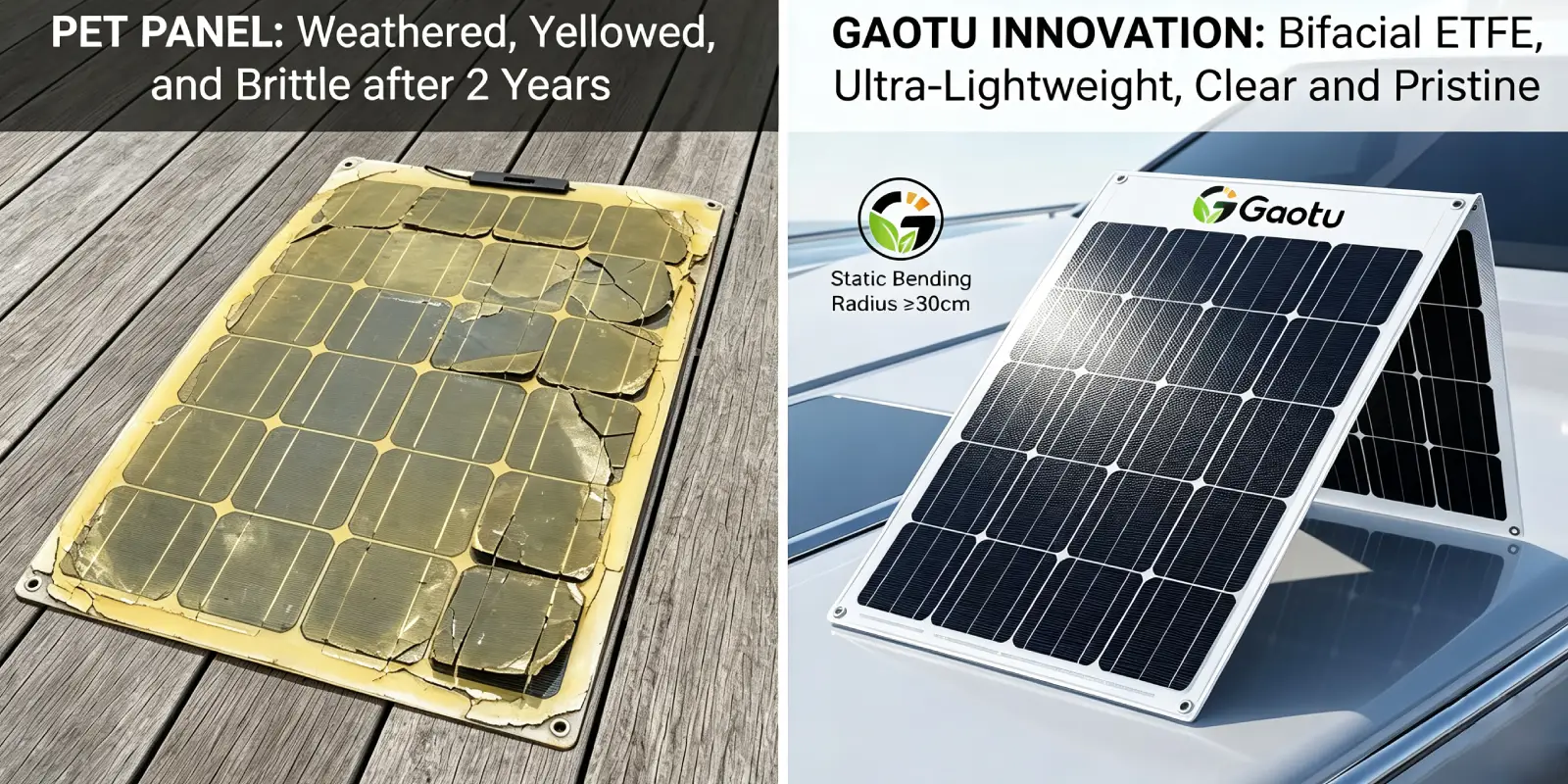
A mass-produced polyester plastic. While highly affordable and lightweight, PET has weak molecular bonds when exposed to continuous thermal stress and ultraviolet radiation.
ETFE (Ethylene Tetrafluoroethylene)
A fluorine-based plastic molecule. ETFE possesses an incredibly strong carbon-fluorine bond. This gives it massive chemical resistance, high thermal stability, and self-cleaning properties originally engineered for aerospace applications.
2. Head-to-Head Technical Comparison (The Data)
When conducting factory audits or analyzing spec sheets, rely on concrete laboratory metrics rather than supplier promises. Here is how the two materials perform under standard testing environments:
|
Performance Metric
|
PET Flexible Panels
|
ETFE Flexible Panels
|
|---|---|---|
|
UV Resistance (Accelerated Test)
|
Severe yellowing after 250 hours
|
Zero degradation after 1000+ hours
|
|
Light Transmittance Ratio
|
~89% (Decreases over time)
|
~95% (Stable over 10+ years)
|
|
Operating Temperature Ceiling
|
70°C (Risk of thermal melting)
|
150°C (High thermal tolerance)
|
|
Surface Friction & Maintenance
|
High friction (Gathers dirt/dust)
|
Textured, self-cleaning hydrophobic
|
|
Expected Lifespan (Outdoor)
|
1 to 3 Years
|
10 to 15+ Years
|
The UV Aging Lab Test: Hours to Failure
In accelerated UV weathering tests (such as ASTM G154 standards), PET panels show visible yellowing and delamination within 250 to 300 hours. Once PET turns yellow, its light transmittance drops significantly, causing a permanent 30%–40% power drop.
In contrast, premium ETFE flexible solar panels withstand over 1,000 consecutive hours of intense UV exposure with zero yellowing and less than 1% degradation in optical clarity.
Light Transmittance and Power Yield
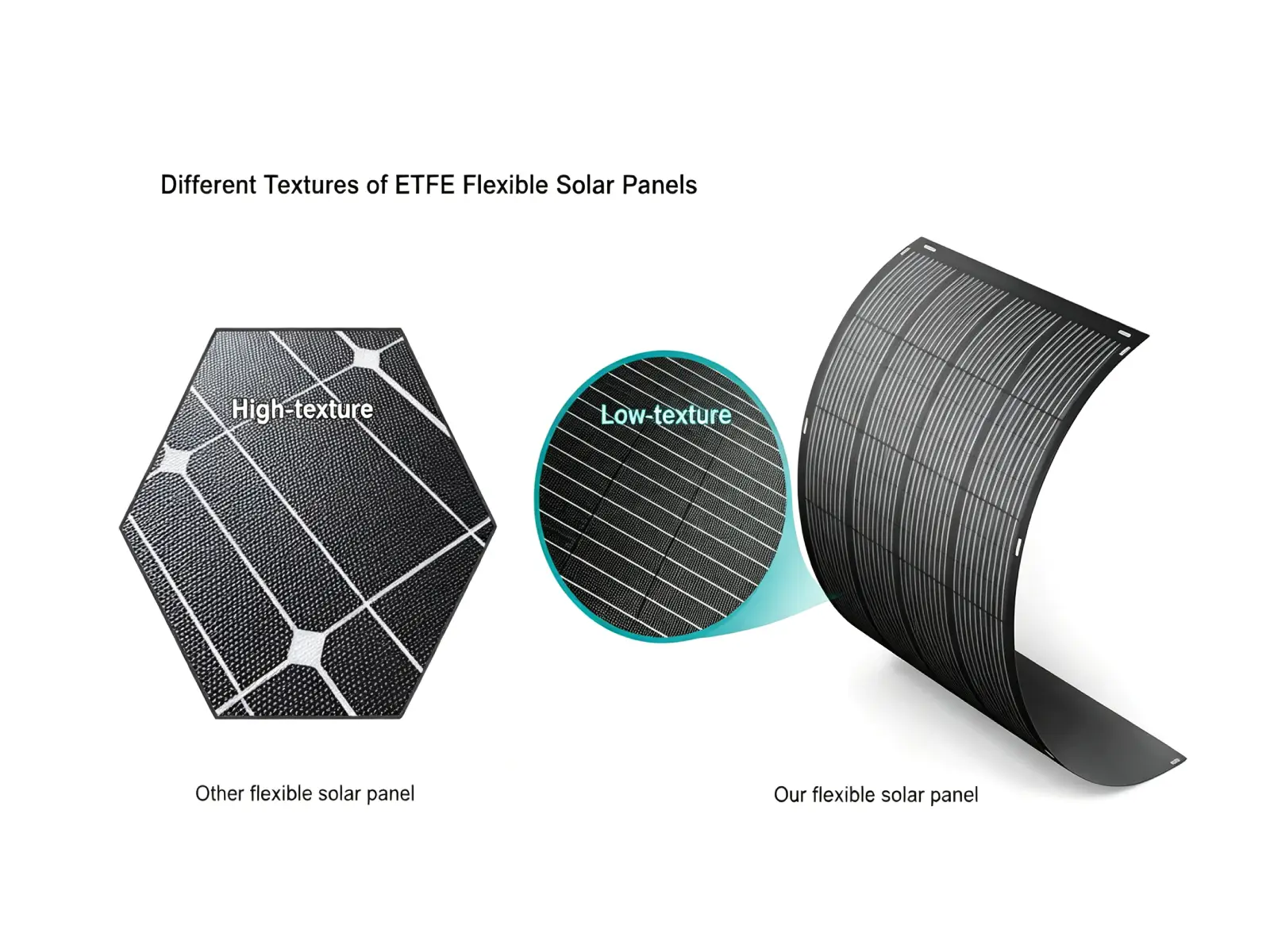
ETFE features a natural light transmittance of up to 95%, whereas PET caps out at around 89%. Furthermore, top-tier manufacturers texture the ETFE layer. This tiny honeycomb pattern reduces light reflection, allowing the underlying monocrystalline cells to absorb more ambient and low-angle sunlight.
3. Why Material Choice is the Root Cause of Hot Spots and Micro-Cracks
The choice of surface material directly impacts the internal mechanical stress of the crystalline silicon cells. Because PET degrades and becomes brittle under the sun, it loses its elasticity. When a brittle PET panel expands and contracts during daily temperature fluctuations, it transfers the structural stress directly to the solar cells.
This structural stress triggers invisible micro-cracks. Over time, these micro-cracks block electrical currents, generating localized high resistance known as hot spots. Hot spots can cause the panel to burn out completely or even melt the mounting surface.
4. How Gaotu Innovation Redefines ETFE Engineering: Ultra-Lightweight & Bifacial
Understanding the limits of standard single-sided ETFE panels, Gaotu Innovation has engineered a next-generation solution that addresses the weight and efficiency limits of traditional solar procurement.
Core Structural Configuration
☀️ Top Sunlight ☀️ ┌──────────────────────────┐ │ Military-Grade ETFE │ ◄── High Transmittance (95%) ├──────────────────────────┤ │ Monocrystalline Cell Core│ ◄── Safe Static Bending Radius ≥30cm ├──────────────────────────┤ │ Bifacial Translucent ETFE│ ◄── Absorbs Ground/Deck Reflections └──────────────────────────┘ ▲ ▲ ▲ ☀️ Rear Albedo Light ☀️
Military-Grade Double-Sided ETFE
While some suppliers use ETFE on the front and cheap TPT/PET on the back to cut costs, Gaotu Innovation utilizes dual-layer military-grade ETFE encapsulation. By wrapping our premium monocrystalline cells with ETFE on both the front and rear sides, we achieve total environmental sealing.
The Secret to Ultra-Lightweight Design
By eliminating heavy fiberglass and aluminum backing sheets, our dual-ETFE structure achieves a massive ultra-lightweight profile. This structural design drops the weight by up to 60% compared to standard panels, making it the perfect choice for load-sensitive commercial installations, marine yachts, and sleek RV configurations.
Optimized Mechanical Compliance
Our advanced dual-ETFE encapsulation ensures the module maintains a strict structural safety buffer, maintaining a certified static bending radius of ≥30cm. This precision engineering protects the internal monocrystalline matrix from micro-cracks during installation on curved profiles while maximizing the power-to-weight ratio.
Additionally, our bifacial technology leverages the translucent rear ETFE layer to capture albedo reflections from white roofs or water, boosting your extra power yield by up to 25%.
Conclusion: Protect Your Brand with Sourcing Intelligence
If your business targets the premium marine, RV, or commercial off-grid markets, importing PET panels is a short-sighted cost-cutting measure that leads to warranty claims. Sourcing high-grade ETFE panels guarantees lower degradation rates, satisfied clients, and a stronger brand footprint.
Before deploying your capital into a new batch of inventory, make sure you understand the complete manufacturing roadmap of your Chinese partners.
If you are looking to audit your supply chain or want a deeper understanding of compliance, check out our comprehensive Ultimate Guide to Choosing a Flexible Solar Panel Supplier in China to discover how to identify real factories, avoid customs delays, and secure wholesale OEM agreements.
Ready to elevate your inventory with our ultra-lightweight bifacial ETFE technology? Contact the Gaotu Innovation Expert Team Today for Technical Datasheets and Free Custom Samples!
Related Posts

GTPOW 820W Balcony Solar Kit: Drill-Free Home Solar Solution
Picture this: every morning, the sun rises over your balcony—and instead of just warming your…
How Portable Solar Panels Benefit Your Camping Trips
Heading out of cities to embrace nature has made camping an increasingly popular way for…
2026 Global Portable Solar Panel Wholesale Sourcing Guide
1. Quick Key Takeaways for Wholesalers If you’re looking for reliable portable solar panel wholesale…

Leave a Reply