

Solar Power Knowledge
How Do Plug-in Solar Panels Work? A Complete Guide to Inverters, Connections, and System Choices
 Gaotu Innovation

Quick Answer
Plug-in solar panels work as a complete system, not a single product. A solar panel produces DC electricity; a matched inverter (or charge controller) converts or regulates that power; and a defined connection method delivers it to a household circuit, a battery, or a portable power station.
A standard solar panel cannot be plugged directly into a wall outlet. The inverter, protection functions, connectors, and connection method must be designed and approved as one system. For a full overview of available panels, see our wholesale solar panels range.
Key Takeaways
-
A solar panel outputs DC power — a plug-in system needs a suitable inverter to produce usable AC power, or a charge controller to charge a battery.
-
Never connect a bare solar panel to a wall outlet. A physical plug adapter does not make an incompatible system safe.
-
Panel voltage (Voc/Vmp), current, inverter input range, connector type, and local requirements must be checked together.
-
Household plug-in systems and portable power station setups follow two different electricity paths and are not interchangeable.
-
For distributors and OEM buyers, the complete system package and documentation matter more than panel wattage alone.
How Do Plug-in Solar Panels Work? The Basic Energy Path
The core process is simple:
Solar panel → inverter or charge controller → specified household connection or battery system
-
The panel captures sunlight and produces direct current (DC). A typical residential panel might have a Vmp around 30–40V and an Imp of 10–13A — but these numbers vary widely by model.
-
The inverter converts DC to AC (for household use), or the charge controller regulates DC (for battery charging).
-
The connection method delivers the power — through a specified AC plug and circuit, or into a battery or power station input.
Why the inverter matters so much: it is the control point. It tracks the panel’s maximum power point (MPPT), converts or regulates voltage, disconnects under fault or grid-loss conditions, and communicates with monitoring. A plug-in solar system is not “a panel with a longer cable” — the inverter, protection, connector, and connection method are engineered as one unit.
What Components Are in a Complete Plug-in Solar System?
A complete system may include:
-
One or more solar panels
-
A specified microinverter or string inverter (or charge controller for battery setups)
-
DC cables and connectors (e.g., MC4)
-
An AC cable and plug rated for the intended circuit
-
Mounting brackets or balcony/roof support parts
-
Monitoring equipment (app or gateway)
-
Optional battery storage
-
Product labels, wiring diagram, and installation instructions
Before buying, confirm whether the product is sold as a panel, a kit, or a complete system. This single question prevents most compatibility mistakes. Our GTPOW balcony plug-and-play PV system is a good example of a complete, pre-matched kit.
Plug-in Household System vs. Portable Power Station: What’s the Difference?
This is where most buyers get confused. The two paths are fundamentally different:
| Household plug-in system | Portable power station setup | |
|---|---|---|
| Energy path | Panel → grid-connected inverter → household AC circuit | Panel → power station PV input → battery → AC/DC output |
| Output type | AC, synchronized to the home circuit | AC from the station’s built-in inverter |
| Grid interaction | May be grid-tied (subject to local rules) | Off-grid only; no grid connection |
| Typical use | Daytime household consumption | Camping, backup, renters, portable use |
| Key compatibility check | Inverter certification and connection method | PV input voltage/current range, connector, polarity |
| Backup during outage | Not automatic — grid-tied systems usually shut down | Yes, within battery capacity |
For the battery-charging path, explore our portable solar panel OEM/ODM solutions to match a panel to your power station input.
Can You Plug a Solar Panel Directly Into a Wall Outlet?
No. A standard solar panel produces uncontrolled DC electricity. A household wall outlet expects controlled AC at a specific voltage and frequency, with grounding and protection.
A grid-connected plug-in system may supply AC through its specified inverter and connection method — but only where local requirements allow it. Key factors that must align:
-
Voltage and frequency match
-
Current and protection ratings
-
Grounding and residual-current protection
-
Anti-islanding behavior during grid outage
-
Local certification or approval for the exact inverter model
A plug adapter does not substitute for any of these. And a portable power station’s AC outlet is not a household grid connection — it is the station’s own inverter output.
What Does the Inverter Actually Do? A Closer Look
The inverter performs several jobs at once:
-
DC to AC conversion with high efficiency (modern microinverters typically 95–97%)
-
MPPT tracking to harvest maximum panel power across changing sunlight
-
Voltage and current regulation within the panel’s operating window
-
Fault and grid-condition disconnection (anti-islanding, over/under-voltage)
-
Monitoring and communication
A worked example: a 400W panel with Vmp around 34V and Voc around 41V needs an inverter whose input range comfortably covers that window — for example, an MPPT range of 25–60V and a max input voltage above 41V. A panel that “looks the same” may have a Voc of 50V and exceed a smaller inverter’s limit. Always match the panel datasheet to the inverter datasheet.
What Should Apartment and Balcony Buyers Check?
Before focusing on panel wattage, check the installation context:
-
Is balcony or exterior mounting permitted by the building or landlord?
-
Can the panel remain outdoors safely (wind load, waterproofing)?
-
Is the cable route safe and short enough to avoid voltage drop?
-
Will the system be fixed, removable, or portable?
-
Does the local market allow plug-in grid connection, and with what certification?
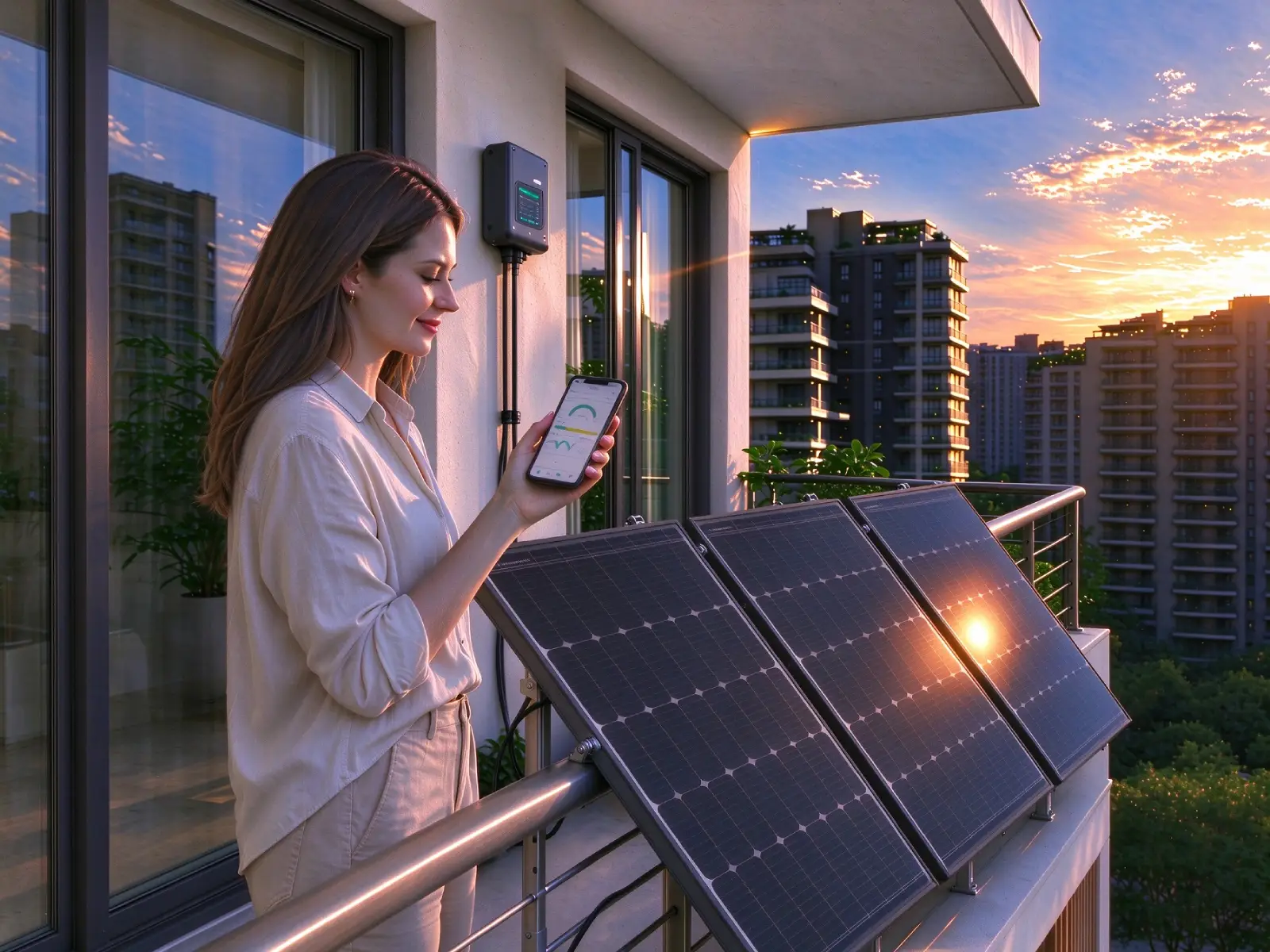
For renters who cannot make permanent changes, a portable panel plus power station is often the more practical route. A fixed plug-in arrangement suits properties with an approved mounting location and a documented connection method — our balcony plug-and-play PV system is designed for exactly this scenario.
What Should Retailers and Distributors Verify Before Ordering?
For B2B buyers, the biggest risk is comparing incomplete quotations. Before placing an order, request:
-
Exact panel model and datasheet
-
Exact inverter model, input range, and certification for the target market
-
Supported connector and cable configuration
-
System wiring diagram and mounting instructions
-
User manual and safety labels
-
Documents covering the exact model and intended market
-
Packaging details and change-control process from sample approval to bulk production
A quote for “the panel alone” cannot be compared with one that includes the inverter, custom cables, packaging, labels, and documentation. For OEM projects, also confirm whether the manufacturer supports custom dimensions, rear cable exits, connector changes, private-label packaging, and repeat production. To discuss a complete system package, contact our team.
FAQ About Plug-in Solar Panels
Do plug-in solar panels work without an inverter?
A standard panel cannot supply normal AC household power without an appropriate inverter. It can connect to a charge controller, battery, or power station instead, depending on system design.
Can any solar panel be used with a plug-in kit?
No. The panel must match the inverter’s voltage, current, power, connector, and operating limits — and the mounting and cable configuration must also be suitable.
Do plug-in solar panels provide backup power during an outage?
Not automatically. Most grid-tied systems stop operating when the grid is down. Backup requires a separately documented battery and inverter architecture designed for that function.
How many panels do I need for a plug-in system?
It depends on your goal. A single 400W panel may offset a few hundred watts of daytime load; a balcony kit of 1–2 panels is common for self-consumption. For meaningful savings, size the system to your daytime baseline load and local rules.
Will a plug-in system make my electricity meter run backwards?
Not necessarily. Behavior depends on the meter type and local regulations. Some markets require a bidirectional meter or specific approval; others restrict export. Confirm with your utility before installing.
Do I need approval to install plug-in solar?
Requirements vary by country, state, and even building. Some markets have simplified registration for certified plug-in kits; others require full grid-connection approval. Always check the exact inverter certification and local rules.
Can I use a plug-in system in an apartment or on a balcony?
Often yes, if mounting is permitted and the connection method is approved. Portable panel plus power station setups are the most renter-friendly option; fixed balcony mounts require landlord or building approval.
What happens if the panel voltage exceeds the inverter’s input range?
The inverter may shut down, derate, or be damaged. Always verify that the panel’s Voc at the lowest expected temperature stays below the inverter’s max input voltage.
Final Thoughts
Plug-in solar panels work as part of a complete electrical system. The panel produces DC power; the inverter, battery, connector, mounting, and connection method determine how that power can be used — and whether it is safe and compliant.
-
For consumers: first identify your goal — daytime household use, battery charging, or portable backup — then match the panel to the inverter or power station input.
-
For distributors: verify the complete product package and the documents supporting the exact configuration for your target market.
Ready to move forward? Browse our wholesale solar panels, explore portable solar panel OEM/ODM options, or contact us for a complete system quotation.
About the Author
Alice — Sales Director at Gaotu Innovation, with 9 years of experience in PV system design. Specialized in custom off-grid solar systems and helping global B2B clients turn concepts into market-ready energy solutions. Expert in RV, marine, balcony, and portable PV applications.
Subscribe to our newsletter for product updates and market insights.
Related Posts
Canton Fair Live | Huge Crowds! Maodi’s Portable Solar‑Storage Products Are a Smash Hit
Heading to Guangzhou for China’s Premier Trade Show As autumn sets in, all eyes turn…
Gaotu Smart Solar Outdoor Umbrella | Tap Into the Fast-Growing Outdoor Clean Energy Market
The outdoor sector booms with new opportunities; ordinary shade umbrellas lack distinction. Markets for backyard…
2026 Global Portable Solar Panel Wholesale Sourcing Guide
1. Quick Key Takeaways for Wholesalers If you’re looking for reliable portable solar panel wholesale…


Leave a Reply