

Solar Power Knowledge
Best Flexible Solar Panel Manufacturers | B2B Guide (RV & Marine)
 gaotu
gaotu
Abstract
This buying guide targets B2B distributors, marine integrators, RV upfitters and off-grid system builders selecting flexible solar panel manufacturers in 2026. Instead of simply ranking brands, it breaks down three core flexible panel categories and reveals critical factory evaluation criteria including cell binning, encapsulation material, bend radius, junction box sealing and SKU-matched certifications. It also differentiates panel failure modes between RV and marine scenarios, introduces Gaotu Innovation’s 18-year PV OEM/ODM manufacturing strengths, and provides a complete vendor evaluation checklist and common sourcing pitfalls to help buyers select reliable long-term manufacturing partners rather than cheap commodity suppliers.
Most B2B buyers searching for the best flexible solar panel manufacturers are not looking for a brand name to put on a website. They are looking for a factory that will still answer the phone in month eighteen, when a batch of panels has been sitting on a boat deck through two summers and a distributor is asking why the junction boxes are weeping.
That is a different question from “who makes the best flexible solar panel.” It is a sourcing question, and it deserves a sourcing answer.
This guide is written for distributors, marine integrators, RV upfitters, and off-grid system builders who are choosing a flexible panel manufacturing partner in 2026. It covers what actually separates factories, how to read a flexible panel spec sheet like a buyer instead of a shopper, and where a factory like Gaotu Innovation fits into the picture.
Start With the Real Question: What Are You Buying?
Flexible solar panels are not a single product category. They are a family of products that share one trait—they bend—and differ in almost everything else. Before comparing manufacturers, a B2B buyer needs to know which of these they are actually sourcing:
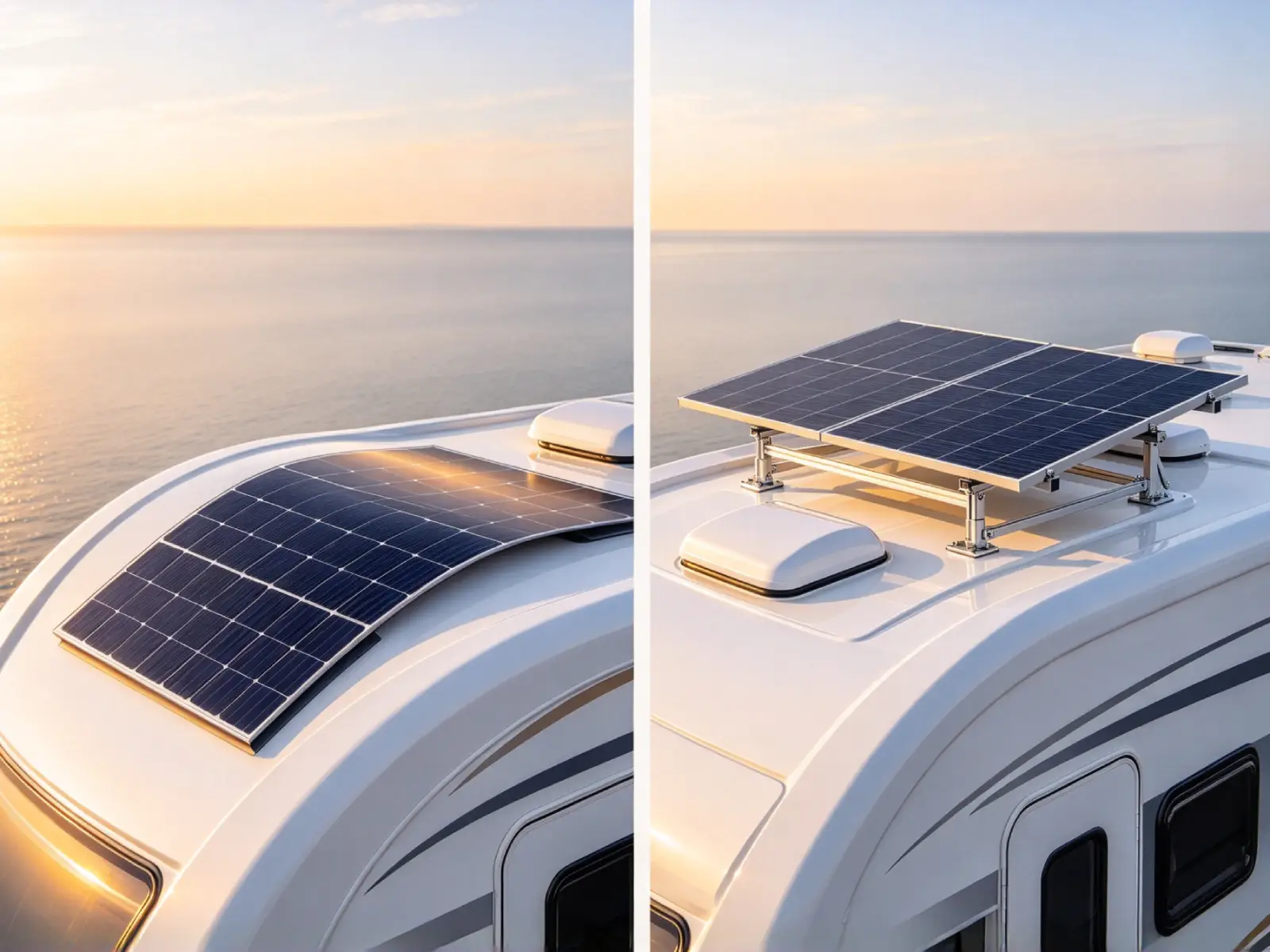
Laminated flexible panels for permanent mounting on curved surfaces. These are the workhorses of the RV and marine aftermarket. They use ETFE or PET front sheets, monocrystalline cells, and a thin encapsulation that allows a defined bend radius. They are bonded to the mounting surface with adhesive and are expected to last 10–15 years.
Semi-flexible panels with a thin aluminum or composite backing. These bend slightly but hold a flatter profile. They are common in applications where the surface is only mildly curved and the installer wants a more rigid feel.
Portable and foldable panels for temporary deployment. These are a different product category entirely—designed to be folded, carried, and redeployed, not permanently bonded. Gaotu Innovation manufactures these alongside our flexible line, and they serve a completely different buyer profile.
A manufacturer who is strong in one of these categories is not automatically strong in the others. When you evaluate the best flexible solar panel manufacturers, the first filter is: do they actually build the type of panel you are sourcing, at the volume and quality level your channel requires?
What Actually Separates Flexible Panel Factories
There is a temptation to compare factories on price per watt and call it a day. Price matters, but for flexible panels specifically, price is a lagging indicator. Factories that cut corners on materials show up cheaper in a quote and more expensive in a warranty claim. Here is what to look at instead.
Cell sourcing and binning discipline
A flexible panel is only as good as the cells inside it. Factories that buy cells on the spot market, with no consistent binning, produce panels whose actual output drifts from batch to batch. That drift is invisible on a spec sheet and very visible when your customer’s MPPT controller keeps throwing errors.
Ask a prospective manufacturer how they source cells, whether they bin in-house, and what their power tolerance is per batch—not per datasheet. A factory that flash-tests every panel and can show you the distribution is a different animal from one that quotes a ±3% tolerance and hopes for the best.
Encapsulation and front sheet material
This is where flexible panels live or die in the field. PET front sheets are cheaper and degrade faster under UV. ETFE front sheets cost more and hold up longer. The encapsulation layer beneath the cells determines whether moisture ingress becomes a problem in year three or year ten.
A serious manufacturer will tell you exactly what materials they use, why, and what conditions void the warranty. A factory that is vague about materials is usually vague about everything else.
Bend radius honesty
Every flexible panel has a minimum bend radius. Exceed it and you stress the cells, the busbars, and the encapsulation. Some manufacturers publish a generous bend radius that assumes ideal conditions and no thermal cycling. Others publish a conservative number that accounts for real-world installation.
For a B2B buyer, the conservative number is the useful one. If a factory cannot explain how their bend radius was tested, assume the published number is optimistic.
Junction box and cable sealing
Flexible panels are often mounted in wet, vibrating environments. The junction box is where most field failures start. Look for manufacturers who can describe their sealing method, their cable gland design, and how they test for moisture ingress. “IP67” on a spec sheet means nothing if the junction box is glued on with the same adhesive used for the backsheet.
Certification scope that matches the SKU
This is the single most common compliance problem in flexible panel sourcing. A factory holds an IEC certificate for one model, then ships a physically different custom panel under the same certificate. If the certificate does not name the exact model and dimensions you are importing, it does not cover you.
Gaotu Innovation maintains certifications across CE, UL, FCC, PSE, and RoHS for our product lines, and we match documentation to the specific SKU being shipped. For custom configurations, we work within pre-certified electrical architectures wherever possible, and we are explicit about when a delta test is required.
The RV vs. Marine Split: Same Product, Different Failure Modes
A common mistake among new B2B buyers is treating “RV and marine” as one market. They buy the same flexible panel and expect the same result. In practice, the two environments stress panels in different ways.
RV installations deal with vibration, thermal cycling, and occasional road debris. The panel spends most of its life flat on a roof, heating and cooling daily. The most common failure modes are junction box fatigue, cable chafing, and adhesive failure at the edges.
Marine installations deal with salt spray, constant moisture, and mechanical flexing from hull movement. The most common failure modes are moisture ingress at the junction box, corrosion of the busbars, and delamination at the edges where the panel flexes against the mounting surface.
A manufacturer who understands this distinction will ask you where the panels are going before quoting. They will recommend different encapsulation, different junction box sealing, and different cable specs for marine versus RV. If a factory quotes you the same panel for both without asking, they are selling a commodity, not a solution.
Gaotu Innovation’s Position in the Flexible Panel Supply Chain
Gaotu Innovation (Shenzhen) New Energy Group has been manufacturing PV products for over 18 years, with three production bases across Dongguan and Indonesia and a 1GW annual capacity. We operate as an OEM/ODM partner rather than a retail brand, which means our business is built around the needs of distributors, installers, and brand owners rather than end consumers.
For flexible solar panels specifically, we offer:
- Flexible solar series for rooftops, carports, and curved mounting surfaces, available for bulk distribution
- Portable and foldable solar panels with monocrystalline cells up to 25% efficiency, IP65–IP68 rated, for RV, camping, and emergency power
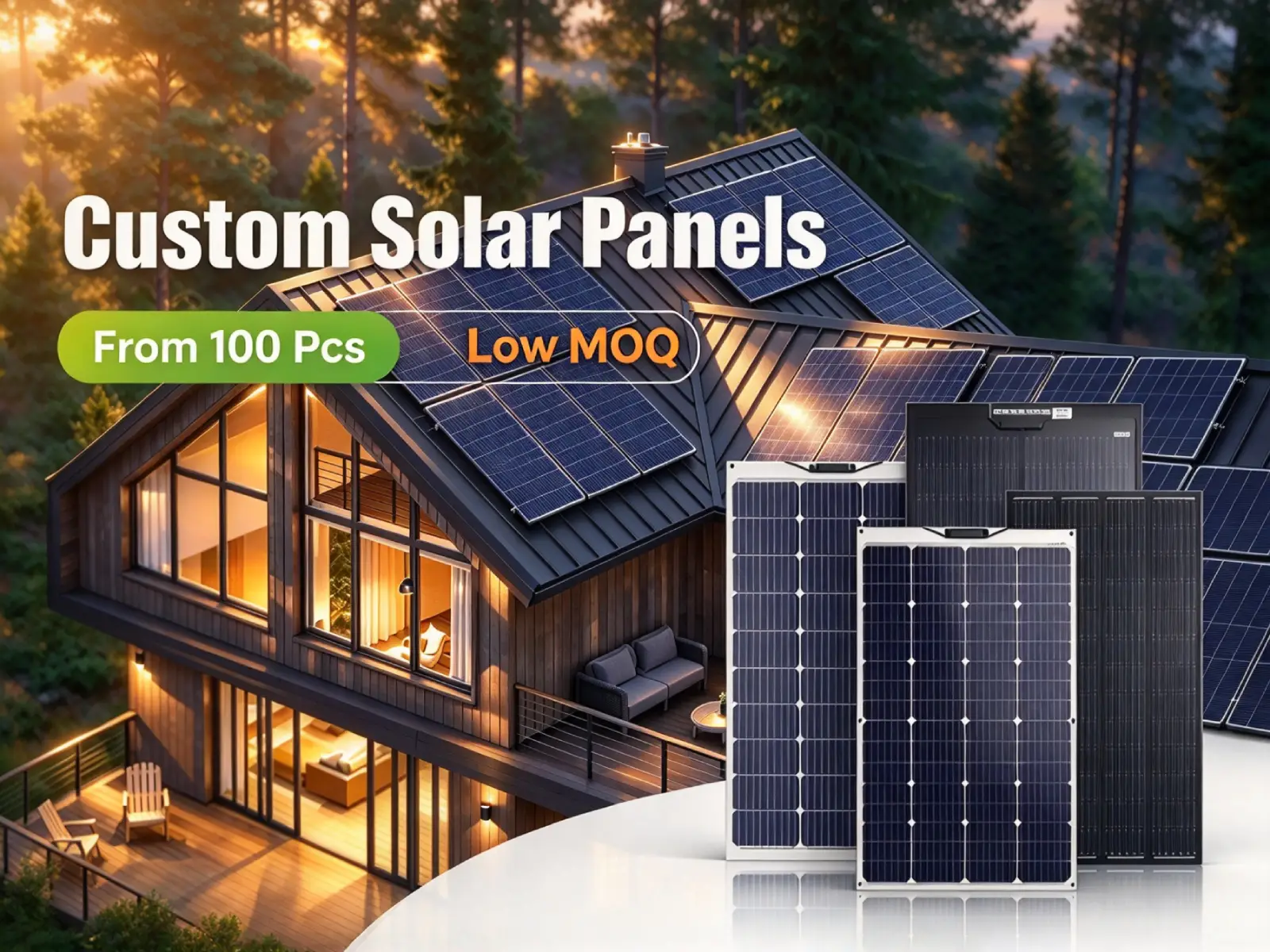
- OEM/ODM services covering private labeling, custom packaging, and custom electrical configurations, with a minimum order quantity of 50 pieces for non-standard specs
- Certification support across CE, UL, FCC, PSE, and RoHS for destination markets
- R&D capability with 30+ engineers and 380+ global patents, including 72-hour prototyping for custom development
We are not the cheapest factory you will find, and we do not try to be. Our positioning is built around repeatable quality, honest documentation, and the kind of support that keeps a distributor’s phone from ringing with warranty complaints.
A Practical Vendor Evaluation Checklist
If you are comparing flexible solar panel manufacturers in 2026, here is a checklist you can run against any candidate—including us.
Product fit
- Do they manufacture the specific type of flexible panel you need (laminated, semi-flexible, or foldable)?
- What is their minimum order quantity for standard and custom specs?
- What wattage range and dimensions can they produce?
Quality evidence
- Can they provide EL images and flash test reports for production batches, not just samples?
- What is their stated power tolerance, and how do they verify it?
- What is their field failure rate, and can they show data?
Materials and construction
- What front sheet material do they use (ETFE vs. PET), and why?
- What is the tested bend radius, and how was it validated?
- How is the junction box sealed, and what is the ingress protection rating?
Compliance
- Which certifications do they hold, and do those certificates name the exact models you are importing?
- For custom configurations, do they provide delta test documentation or a clear statement of what is and is not covered?
Commercial terms
- What is the lead time for a first order versus a reorder?
- What are the payment terms, and how are shipping and Incoterms handled?
- What is the warranty period, and what does the RMA process actually look like?
Support
- Who is your technical contact, and are they an engineer or a salesperson?
- What happens when an installer has a question mid-installation?
- Can they provide references from other B2B buyers in your region or channel?
A factory that can answer all of these clearly is worth a trial order. A factory that deflects on materials, certifications, or references is not.
Common Mistakes B2B Buyers Make With Flexible Panels
Buying on price per watt alone. Flexible panels are not a commodity. The cheapest quote usually reflects cheaper materials, thinner encapsulation, or skipped certification—all of which show up later as warranty claims.
Assuming all ETFE is the same. ETFE front sheets vary in thickness and UV stabilization. A thinner ETFE sheet saves the factory money and costs the installer lifespan.
Skipping the sample order. For a first order from a new factory, always buy samples and inspect them. Check the lamination for bubbles, the junction box for sealing quality, and the flash test data for consistency. A sample tells you more than a spec sheet.
Ignoring the installation instructions. Many flexible panel failures are installation failures—bending beyond the rated radius, bonding to a rough surface, or trapping moisture underneath. A good manufacturer provides clear installation guidance and stands behind it when the installer follows it.
Not asking about the reorder experience. A factory’s first order is a sales effort. The reorder is where their real process shows. Ask references about what the third and fourth orders were like, not just the first.
Working With Gaotu Innovation
If you are sourcing flexible solar panels for RV, marine, off-grid, or portable applications in 2026, we are happy to talk through your requirements. We work with distributors, installers, and brand owners across 60+ countries and support both OEM and ODM engagements.
Contact Gaotu Innovation
Email: info@gt-pow.com
Phone/WeChat: +86 13510536176
Website: gtpowsolar.com
We will ask you where the panels are going, what your channel looks like, and what your compliance requirements are before we quote. That is not a sales tactic—it is how we avoid shipping the wrong panel to the wrong market.
FAQ
Who are the best flexible solar panel manufacturers for B2B buyers in 2026?
There is no single best manufacturer, because “best” depends on your channel, your volume, and your destination market. The right partner is the factory that manufactures the specific type of flexible panel you need, can prove their quality with batch-level test data, holds certifications that match your exact SKUs, and supports you after the sale. Compare candidates on evidence, not on brand recognition.
How do I choose between ETFE and PET flexible panels?
ETFE front sheets cost more but last longer under UV exposure and are the better choice for permanent outdoor installations, especially marine. PET is cheaper and suitable for portable or temporary applications where lifespan is less critical. Ask your manufacturer which they recommend for your specific use case, and why.
What MOQ should I expect from a flexible solar panel manufacturer?
Most factories require 500–1,000 pieces for custom specs. Gaotu Innovation’s minimum is 50 pieces for non-standard sizes, voltages, and designs, which makes custom flexible panels accessible to smaller distributors and project developers.
How long do flexible solar panels last?
A quality flexible panel with an ETFE front sheet is typically rated for 10–15 years, compared to 25–30 years for rigid glass panels. Actual lifespan depends heavily on installation quality, mounting surface, and environmental conditions. Marine installations and high-UV environments will see shorter lifespans than sheltered RV installations.
Can flexible solar panels be used on a boat or RV roof?
Yes, and this is one of their primary applications. The key requirements are a compatible mounting surface, correct adhesive, respect for the bend radius, and a panel rated for the environment. Marine installations should use panels with marine-grade junction box sealing and corrosion-resistant busbars.
Related Posts
How Your Roof Secretly Kills Your Power Output
Most homeowners make the same costly mistake when going solar. They splurge on higher-wattage, premium…
Which Type of Solar Panel Is Best for Your Project? Complete Buyer’s Guide
Solar power has become extremely popular these days. People install solar panels for home rooftops,…
How to Find Reliable Flexible Solar Panel Wholesale Supplier
Flexible solar panels have become one of the fastest-growing renewable energy products for off-grid applications,…
Leave a Reply