

Solar Power Knowledge
Wholesale Solar Panels Sourcing Guide: MOQ, Container Loading, and Supplier Vetting
 gaotu
Who this guide is for: Solar installers, distributors, EPC contractors, and project developers who purchase PV modules in volume. If you are looking for a single panel for a residential rooftop, this article is not for you. What follows assumes you already know solar works and need to know how to buy it at wholesale without getting burned on lead times, certification mismatches, or hidden logistics costs.If you are placing a multi-container order and need to verify a factory’s long-term production capacity, read our guide on bulk supply solar panels.
The Real Cost of a Bad Wholesale Order
Most first-time wholesale buyers focus on the per-watt price. Experienced procurement managers know the bigger risks lie elsewhere: a container that arrives two weeks late and idles a crew, a certification document that lists a slightly different model number than the panels on the pallet, or a batch of modules with micro-cracks that only show up under electroluminescence testing after installation.
The difference between a smooth wholesale purchase and a costly one usually comes down to three things you can verify before you wire a deposit: MOQ and container math, certification traceability, and quality evidence. This guide walks through each, with the specifics you need to ask your supplier.
MOQ and Container Loading: The Math That Determines Your Landed Cost
Wholesale solar panels are not priced in a vacuum. The per-watt quote your supplier sends means little until you calculate how many panels fit in a container and what the freight cost adds per watt.
Pallet vs. Container: Know Your Threshold
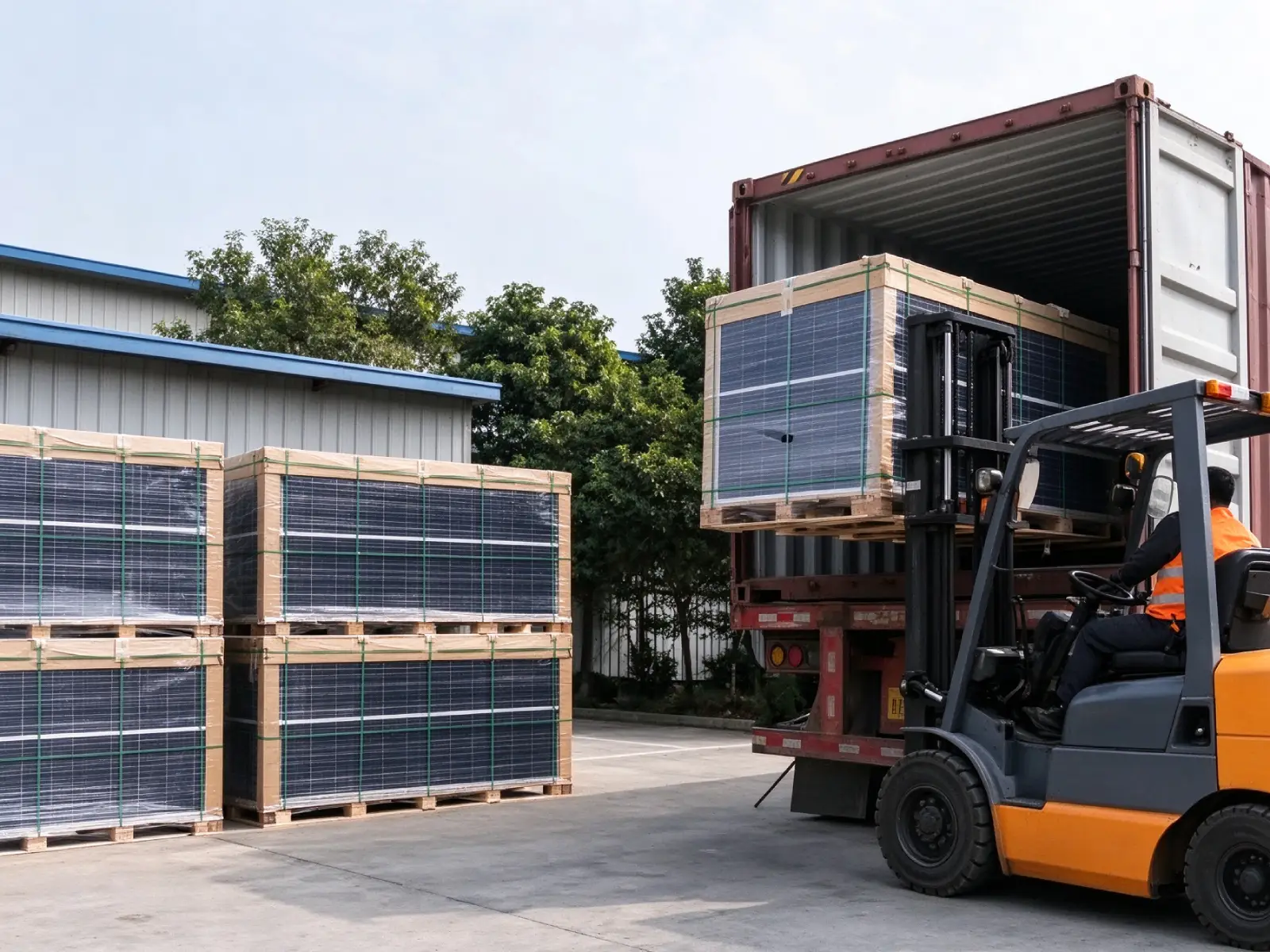
Reputable wholesale suppliers typically offer two entry points. By the pallet is the lower-risk option for distributors testing a new brand or installers with a smaller pipeline. A standard pallet usually holds around 30–36 modules, depending on wattage and frame size. This lets you evaluate quality and compatibility before committing to a full container.
By the container is where the real wholesale pricing kicks in. The industry workhorse is the 40-foot High Cube (40HQ). For mainstream module sizes in the 580W–630W range, the internal dimensions of a 40HQ impose hard limits: roughly 2.69m internal height, 2.35m internal width, and 12.03m internal length. Modules are palletized and stacked vertically; the pallet height plus module width must clear the door height with enough margin for a forklift.
Ask your supplier for their container loading plan as a standard document. A credible supplier will have this ready. It should state the exact module model, pallet dimensions, modules per pallet, pallets per 40HQ, and total wattage per container. If they hesitate or say “we’ll figure it out after you order,” that is a signal.
Mixed Loading: The Flexibility That Separates Good Suppliers
Distributors rarely sell a single wattage. Your downstream installers may need 450W modules for one job and 600W bifacial for another. A supplier that supports mixed container loading—combining different wattages or models to fill one 40HQ—solves a real inventory problem for you. It reduces your warehouse space requirement and lets you respond to varied installer demand without overstocking a single SKU.
When you request a quote, specify whether you need mixed loading and ask for the minimum quantity per model to qualify. Suppliers who can accommodate this without excessive surcharges are worth keeping in your shortlist.
Certifications and Warranty: Verify, Don’t Assume
Every wholesale supplier will tell you their panels are “TUV certified” or “IEC compliant.” The question is whether the certification matches the exact model you are buying, and whether the warranty is something you can actually enforce.
Certification Traceability
The core standards for PV modules are IEC 61215 (design qualification and performance) and IEC 61730 (safety). TÜV Rheinland and equivalent bodies issue certificates against these standards, and their marks are widely accepted by buyers and investors for bankability purposes. For North American projects, UL 61730 is the relevant safety standard.
Here is the practical step most buyers skip: ask for the certificate and the datasheet for the specific model you are ordering, and compare the model numbers character by character. Certificates are issued for specific product families and configurations. If the certificate says “STPXXXS-C72/Ns” and the panels arrive labeled with a different suffix, you have a documentation problem that can stall permitting, inspection, or incentive paperwork.
Warranty: Who Actually Answers the Claim?
Module warranties typically cover two separate things: product/workmanship (defects in materials or manufacturing) and power output (degradation over time). Industry-standard terms for N-type TOPCon modules, for example, often run 15 years product warranty and 30 years power warranty, with first-year degradation capped at 1.0% and annual degradation at 0.40% thereafter.
The number that matters to a wholesale buyer is not the headline year count but who handles the claim. If you are buying from a trading company that sources from a factory, the warranty may technically exist but practically require you to ship defective modules back to a manufacturer you have no relationship with. Ask directly: “If a module fails under warranty, do I file the claim with you, and do you handle the factory communication and replacement logistics?” Get the answer in writing in the supply agreement.
Quality Evidence: What to Demand Before the Container Ships
“High quality” is not a specification. Here are the concrete items a serious wholesale buyer should request before finalizing an order.
Electroluminescence (EL) Test Reports
EL imaging reveals micro-cracks and cell defects that are invisible to the eye. Research on stored PV modules has shown that micro-cracks can propagate even under controlled conditions, with power degradation of 7–10% observed over a one-year storage period in one study. For wholesale buyers, the risk is not just manufacturing defects but transportation damage—modules that left the factory intact but developed cracks during shipping.
Ask for EL test reports on the specific batch or a sampling basis. A supplier who routinely provides EL documentation is signaling that they inspect before shipping, not just after a complaint. (If your order volume is large, make sure their testing sample size scales up—see our checklist for verifying bulk supply capacity.)
Power Tolerance: Positive vs. Negative
Wholesale pricing is usually quoted per watt. If the modules are rated at 580W but the power tolerance is 0 to +5W, every panel delivers at least 580W and potentially up to 585W. If the tolerance is negative (e.g., -3W to +3W), some panels in the batch will underperform their nameplate rating. For volume buyers paying per watt, positive tolerance is a direct value capture. Check the datasheet. It is usually listed as “Power Tolerance” or “Pm Tolerance.”
Flash Test Data
For larger orders, request flash test data for the batch. This gives you the actual measured Pmax for each serial number, not just the nameplate rating. It is the difference between buying a promise and buying verified output.
A Practical Sourcing Checklist
Before you request a formal quotation from any wholesale solar panel supplier, prepare these questions:
Logistics: What is the module model and dimensions? How many fit in a 40HQ? Do you support mixed loading, and at what minimum per model? What is the estimated lead time from deposit to port departure?
Documentation: Can you send the IEC 61215 and IEC 61730 certificates for the exact model quoted? Do the model numbers on the certificate match the datasheet and the nameplate?
Quality: Do you provide EL test reports for the shipment? What is the power tolerance range? Can you provide flash test data for the batch?
Commercial: What is the MOQ by pallet and by container? What are the payment terms? Who is the warranty counterparty, and what is the claim process?
Send us your sourcing requirements for a formal quote
Request a Container Loading Plan and Wholesale Price Sheet
If you are sourcing for an upcoming project or building distributor inventory, the fastest way to get actionable numbers is to request our current container loading plan and wholesale price sheet. The sheet includes available wattages, MOQ by pallet and 40HQ, certification status by model, and lead times by destination port.
We respond within one business day with a formal quotation that includes module specifications, logistics dimensions, and warranty terms. No vague “contact us for pricing”—you get the data you need to calculate landed cost.
This guide is written for commercial buyers. If you are a homeowner seeking a single panel or residential installation, please consult a local installer.
Related Posts

20000 Swift Power Bank – Exclusive Wholesale Catalog
1. Market Pain Points & Sales Logic Battery anxiety is a widespread consumer problem that…
Solar Panel Quotation Requirements: From Inquiry to Quote
Why Every Specification Impacts Solar Panel Quotations Your initial inquiry does not need to be…
Portable Solar Panel OEM: Complete Customization & Wholesale Guide
Market Status and Industry Value of Portable Solar Panel OEM With the popularity of outdoor…


Leave a Reply