

Solar Power Knowledge
Bulk Supply Solar Panels: How to Verify a Supplier Can Actually Deliver at Scale
 gaotu

Who this is for: Procurement managers and supply chain leads at distributors, EPC firms, and installation companies who need to secure module supply at volume—not just find a low per-watt price. If you are comparing quotes for a single pallet, this is not the right page. What follows is about verifying whether a supplier has the operational depth to fulfill bulk orders reliably, shipment after shipment.
The Question Behind “Bulk Supply”
When a buyer searches for bulk supply solar panels, they are not asking “who sells panels cheaply.” They are asking a more specific question: can this supplier handle my volume without breaking?
That question has three parts, and most supplier pages answer none of them. Can you produce or source the quantity I need within my timeline? Do you have the logistics infrastructure to move it without damaging the product or missing the vessel? And when something goes wrong at scale—because at volume, something always does—who absorbs the problem?
The following sections give you the specific evidence to demand from any supplier claiming bulk supply capability, and the red flags that separate real capacity from marketing language.
Production Capacity: Numbers, Not Adjectives
“Large capacity” and “strong production capability” are meaningless phrases. Ask for numbers, and cross-check them against what you already know about the industry.
What to Ask
For a module manufacturer or a supplier with direct factory allocation, the relevant figures are annual module capacity (in GW or MW), current utilization rate, and monthly output of the specific model you are ordering. A supplier running at 95% utilization may not have room for your order. A supplier running at 50% may be desperate enough to take your order but financially unstable.
For a trading company or distributor, the question shifts: which factory holds your allocation, and what is that factory’s capacity? A distributor with no direct allocation is at the mercy of the spot market. That may be fine for small orders, but bulk supply requires a committed source.
The Red Flag
A supplier who cannot name the factory producing your modules, or who gives a capacity figure that sounds implausible relative to their company size, is not a bulk supplier. They are a middleman hoping the order works out.
Inventory and Lead Time Logic
Bulk buyers care about lead time because their own commitments depend on it. A supplier who says “25–30 days” without qualification is either guessing or hiding something.
What to Ask
Request the lead time breakdown: production scheduling time, production run time, testing and EL inspection time, inland transport to port, and vessel booking. For repeat orders, ask whether the supplier holds buffer stock of your target model, and if so, how much. A supplier who keeps finished-goods inventory in your destination region can compress lead time significantly, but only if the inventory is real and the model matches.
The Practical Test
Ask a simple question: “If I place a repeat order for the same model today, what is the earliest date you can guarantee for port departure?” A supplier with genuine bulk capability will give you a date and explain what could move it. A supplier without it will give you a range and hope.
Logistics at Scale: The Damage Rate Nobody Talks About
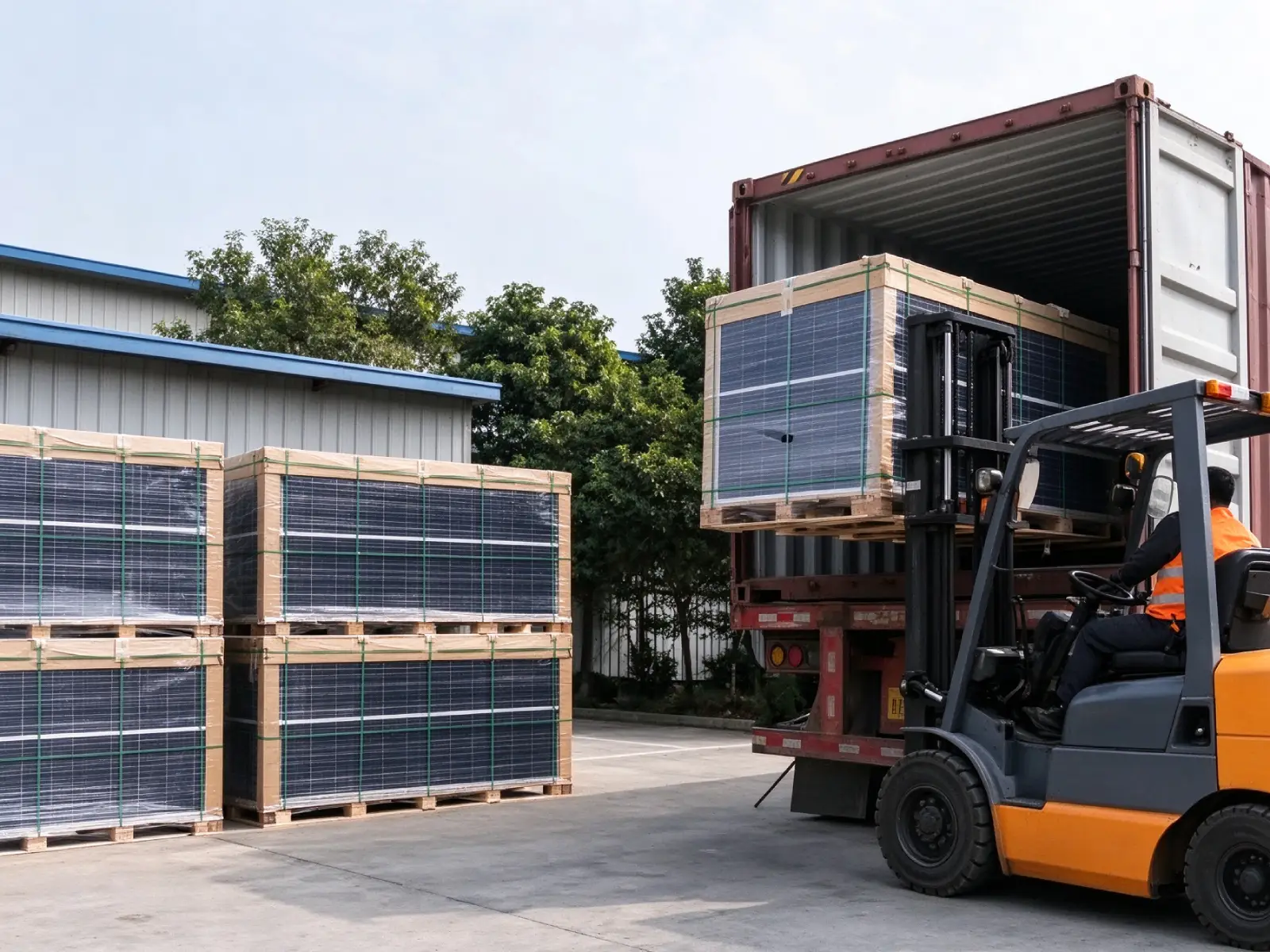
One pallet shipped poorly is an inconvenience. A 40HQ container of modules that arrives with cracked cells or water-damaged packaging is a financial event. (For a detailed breakdown of container math, see our guide on how to buy wholesale solar panels.At bulk volume, packaging and loading discipline become a primary supplier selection criterion, not an afterthought.
What to Ask
Request the packaging specification for bulk shipments: carton strength, corner protection, desiccant usage, and pallet stacking limits. Ask whether the supplier provides loading photos or a loading supervision report for each container. Some suppliers will send photos of the container being loaded, which tells you more about their operational discipline than any certificate.
The EL Connection
As covered in our wholesale solar panels sourcing guide, electroluminescence testing before shipment is standard for serious suppliers.For bulk orders, ask whether the EL sample size scales with the shipment volume. A supplier who tests the same handful of modules regardless of whether you ordered one pallet or twenty is not treating bulk orders with the scrutiny they require.
Financial and Warranty Capacity at Volume
A warranty on a 50-pallet order is worth exactly as much as the supplier’s ability to honor it when a batch-level defect emerges. At bulk scale, a single systemic issue—a bad laminate batch, a junction box supplier change—can trigger a claim that exceeds the margin on the entire order.
What to Ask
Ask directly: “What is the largest warranty claim your company has processed in the last two years, and how was it resolved?” A supplier with genuine bulk experience will have a story. A supplier who has only sold small orders will not.
Also ask about warranty insurance or third-party backing. Some larger manufacturers carry warranty insurance through providers like Munich Re or use escrow arrangements for large contracts. This is not universal, and its absence is not automatically disqualifying, but its presence signals that the supplier has been through the scrutiny of an underwriter.
The Tier 1 Question
BloombergNEF Tier 1 status is a useful but misunderstood signal. It means the manufacturer has supplied modules to projects that received non-recourse financing from banks—it is a proxy for bank acceptance, not a quality guarantee. For bulk buyers, Tier 1 is a minimum filter, not a final selection criterion. A Tier 1 manufacturer can still be insolvent in two years. The question is not “are they Tier 1” but “what else do they have beyond Tier 1.”
A Bulk Supply Verification Checklist
Before you commit a deposit to any supplier promising bulk supply, get written answers to these:
Capacity: What is the monthly output of the exact model I am ordering? What is your current utilization rate? If you are a distributor, which factory holds my allocation?
Lead time: Break down the timeline from deposit to port departure. What buffer stock do you hold, where, and for which models?
Logistics: What is your packaging specification for bulk shipments? Do you provide loading photos or supervision reports per container? What is your historical damage rate at destination?
Warranty at scale: What is the largest warranty claim you have resolved in the past 24 months? Do you carry warranty insurance or third-party backing?
Financial signal: (For larger orders) Can you provide bank references or trade references from buyers who have placed repeat bulk orders?
Request a Bulk Supply Capability Summary
If you are evaluating suppliers for an upcoming bulk requirement, the most efficient next step is to request our current bulk supply capability summary. It covers available models, monthly allocation by model, standard lead time breakdowns, and the logistics documentation we provide per shipment.
We respond within one business day with the specific figures you need to compare suppliers on capability, not just price.
Related Posts

2026 Solar Panel Price: Portable, Foldable & RV Panel Cost
Many shoppers struggle with solar panel pricing: portable solar panels range from low-cost to premium…

Which Type of Solar Panel Is Best for Your Project? Complete Buyer’s Guide
Solar power has become extremely popular these days. People install solar panels for home rooftops,…
How to Order OEM & ODM Portable Solar Panels: Complete Sourcing Checklist
Executive Summary: Sourcing off‑grid solar products involves far more than just solar cell efficiency. For…

Leave a Reply