

Solar Power Knowledge
Can Solar Panels of Different Wattages Be Mixed?
 gaotu
gaotuMany homeowners and off-grid solar users face a common dilemma: their existing solar panels are still functional, and they want to expand their system. However, they own panels of different ages, sizes, and wattages and wonder if these panels can be used together safely. Some people believe mismatched wattages cannot be combined at all, while others casually wire them in series or parallel. This often leads to sharp drops in power generation, abnormal overheating, and even burned-out charge controllers.
Here is the clear conclusion: You can mix solar panels with different wattages, but you cannot wire them randomly. The key matching standard is voltage, not power wattage. By following the correct wiring principles, you can expand your solar system at low cost while avoiding faults and power loss.
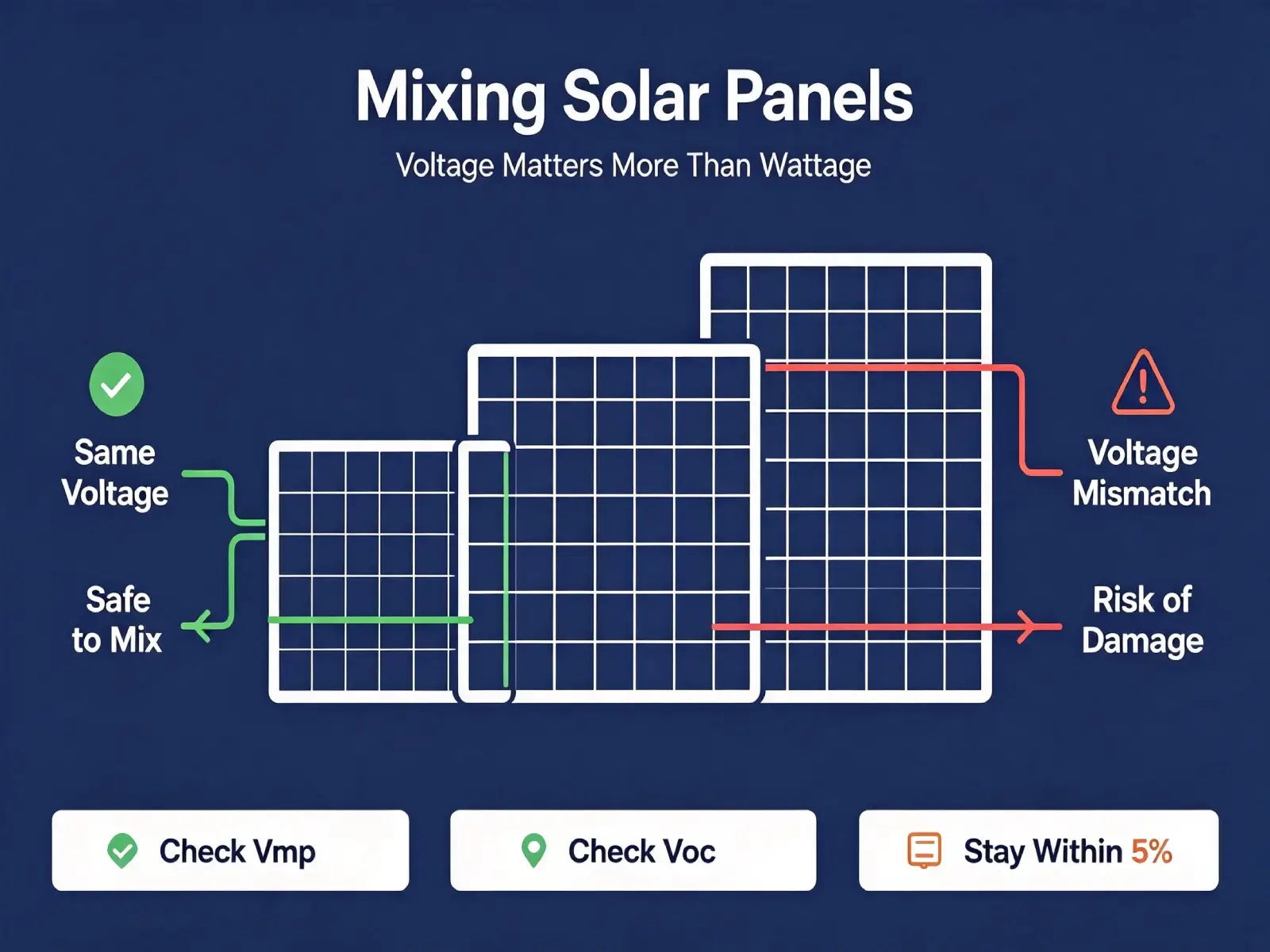
1. Core Principle: Voltage Matters Far More Than Wattage
Most solar panel pairing failures stem from a common misunderstanding: people assume different wattages cause compatibility issues. In reality, the power rating does not prevent panels from working together. The actual factors that determine system stability and efficiency are operating voltage, open-circuit voltage, and working current.
Series and parallel connections operate completely differently and follow separate pairing rules. As long as you understand the requirements of each wiring method, panels with different wattages can work safely and efficiently as a mixed array.
2. Series Connection: The Bottleneck Effect Requires Consistent Voltage
Wiring solar panels in series increases the total system voltage. In a series circuit, voltage adds up while the current remains uniform across all panels. The defining rule here is the total current of the entire string is limited by the panel with the smallest current, known as the bottleneck effect.
For example, if you wire a 24V 120W panel and a 24V 240W panel in series, the matched voltage allows the circuit to work. However, the overall current will be restricted by the smaller 120W panel. The 240W high-power panel cannot run at full capacity, resulting in massive wasted power potential.
Forcing panels with large voltage differences into series connection leads to far worse consequences. Besides drastically reduced power output, it causes localized overheating and accelerated component aging. Long-term improper use poses risks of overheating damage and equipment failure.
To sum up: For series mixing, operating voltage and open-circuit voltage must be nearly identical; different wattages are completely acceptable.
3. Parallel Connection: Strict Voltage Consistency Is Mandatory
Wiring solar panels in parallel increases total current and boosts power output while keeping the system voltage constant. Parallel connections demand stricter parameter matching than series connections.
Panels with similar voltage but different wattages work perfectly in parallel. Each panel operates independently, and their currents add up without extra power loss, making this a highly practical mixing method. In contrast, pairing high-voltage and low-voltage panels directly in parallel causes severe reverse current flow. The higher-voltage panels will continuously feed current back into the lower-voltage ones and disrupt the circuit.
This wrong wiring method drastically cuts power generation and triggers abnormal panel overheating. Over time, it burns out wires and controllers and shortens the lifespan of the entire solar system. The industry safety standard requires: The open-circuit voltage difference between parallel panels must be within 5%.
4. Two Efficient Methods to Mix Different Solar Panels
For mixed new and old solar panels with mismatched wattages, these two user-friendly solutions are ideal for residential and small solar systems, balancing cost and efficiency.
1. Grouped Convergence Method (Low Cost & Most Popular)
The core logic is “group by voltage, then converge uniformly”. Cluster panels with identical voltage parameters into one group. You can wire panels within each group in series to raise the group voltage, ensuring all groups have the same total voltage. Finally, connect all groups in parallel to the charge controller. This method requires no extra equipment, maximizes power output from every panel, and minimizes energy waste.
2. Multi-Tracker MPPT Method (Best Performance & Zero Loss)
If your solar panels have large parameter gaps and big age differences, a multi-channel MPPT charge controller is the best choice. Panels with different voltages and wattages connect to independent MPPT channels separately. Each channel tracks maximum power independently without interfering with others, completely eliminating power loss caused by mismatched panels. This is the optimal solution for mixed solar arrays.
5. Key Operation Tips for Long-Term Stable Operation
1. Stick to the core rule: always prioritize voltage matching, not wattage. Voltage imbalance is the top cause of system faults, while wattage differences do not affect stability.
2. Ensure consistent sunlight conditions: all panels should face the same direction and avoid shading. A single shaded panel will lower the efficiency of the entire array.
3. Match your equipment correctly: check the controller’s maximum withstand voltage before wiring to avoid burnout from excessive total voltage.
6. Final Summary
Remember this simple rule of thumb: Series connection avoids current bottlenecks; parallel connection requires strict voltage consistency. Solar panels of different wattages can be safely mixed and matched. By following voltage matching principles and choosing the right wiring solution, you can expand your solar system economically, cut replacement costs, and maximize the value of all your solar equipment.
Related Posts
Solar Panel and Portable Power Station Compatibility Guide
Core Overview: Most issues of incompatibility, charging failure, slow charging, and equipment burnout between solar…
The Ultimate Guide to Wholesale Solar Panels: Sourcing, Pricing, and Logistics for B2B Buyers
Article Summary This guide helps B2B solar buyers, distributors and EPC contractors source wholesale solar…
Germany’s Balcony PV Boom: Why Small 2‑3 Panel Systems Dominate the Market
It is quite typical to see just two or three solar panels scattered on…


Leave a Reply