

Solar Power Knowledge
Solar Panel Supplier Evaluation Framework: On-Time Delivery, Response Time, Reorder Rate
 gaotu
gaotuCore Summary
Most buyers pick a solar panel supplier based on price, catalog, or how fast the sales rep replies on WhatsApp. That’s not evaluation—that’s guessing. This article gives you a practical framework to answer one question: is your solar panel supplier actually reliable? It covers the three operational metrics that predict reliability, a factory audit checklist you can actually run, and the red flags that should eliminate a supplier before you waste time on price negotiation.
Quick Answers
What’s a good on-time delivery rate for a solar panel supplier? Above 95% is acceptable. But don’t trust the platform number—ask for shipment records from the last 3-6 months and cross-check with customer references.
How fast should a solar panel supplier respond? Under 6 hours is the baseline. Under 2 hours means they have a dedicated team. Test it yourself with a technical question—not a “how much” question.
What reorder rate should I look for? Above 25% suggests customers come back. Above 50% is exceptional. This is the hardest metric to fake because it’s based on real repeat business.
How do I know if a solar panel supplier is a real factory or a trading company? Check the business license, ask for production line counts, request recent production records, and verify the factory address matches the certificate. A real 5GW factory needs 80,000-150,000 m² of production space.
What financial indicators matter for a solar panel supplier? Altman Z-Score above 2.6 is safe. Current ratio above 1.2. Debt-to-equity below 2.0. For large orders, ask for three years of audited financial statements.
You’ve probably done this before. You find a solar panel supplier. Their website looks professional. Their catalog has all the specs you need. The sales rep replies fast, sends you a nice PDF, and quotes a price that’s 5% below the last quote you got. So you place an order. Then the panels arrive two weeks late. Or the certification doesn’t match the model number. Or you email them about a quality issue and get silence for three days. That’s not bad luck. That’s a supplier evaluation problem.
In Step 6 of our [Wholesale Solar Panels: A Complete Procurement Guide for Distributors and EPCs], we said sample verification is non-negotiable. But samples only tell you about the product. They don’t tell you whether the supplier can deliver 500 panels on time, respond to a quality issue in 24 hours, or still be in business when you file a warranty claim in year eight. So how do you actually figure out if your solar panel supplier is reliable? Here’s the framework.
Why Operational Metrics Beat Marketing Claims
Every solar panel supplier says they’re reliable. Every supplier says they have “strict quality control” and “fast delivery.” These are marketing claims, not data. Operational metrics are different. They’re measurable, verifiable, and hard to fake over time. Three numbers tell you more than any catalog: On-time delivery rate Response time Reorder rate Let’s break down each one.
Metric 1: On-Time Delivery Rate
This is the percentage of orders that ship and arrive within the promised timeframe. What to look for: Above 95% is acceptable 100% is ideal, but verify it Below 90% signals logistical bottlenecks Why it matters: A solar panel supplier with a 78% on-time delivery rate will miss one in five orders. For a project with a fixed installation window, that’s not a risk you can absorb. For a distributor with customers waiting on stock, it’s a customer service disaster waiting to happen. How to verify: Platform-reported metrics are a starting point, but they’re not the whole story. Ask for: Shipment records from the past 3-6 months Customer references who can speak to delivery performance Whether delays are typically production-side or logistics-side A solar panel supplier who can’t provide shipment records is telling you something.
Metric 2: Response Time
This is how long it takes for a supplier to respond to your inquiry, quote request, or issue. What to look for: Under 6 hours is the baseline Under 2 hours signals a dedicated sales or support team Under 1 hour is exceptional Why it matters: Response time is a proxy for organizational discipline. A solar panel supplier who takes 48 hours to answer a pre-sales question will take longer to resolve a production issue or a quality claim. Fast response times correlate with better post-sale support and customization handling. How to verify: Test it yourself. Send an inquiry with a specific technical question—not “what’s your price”—and time the response. Then send a follow-up question and see if the speed holds. Some suppliers respond fast to initial inquiries but go silent once you’re in the negotiation phase.
Metric 3: Reorder Rate
This is the percentage of customers who place a second order. What to look for: Above 25% suggests customer satisfaction Above 50% reflects exceptional product quality and service consistency Below 15% is a red flag Why it matters: Reorder rate is the hardest metric to fake. It’s based on actual repeat business—customers who were satisfied enough with the solar panel product, delivery, and support to come back. A supplier with a 57% reorder rate has proven they can retain customers. How to verify: Platform-reported reorder rates are a good starting point. For deeper verification, ask for customer references and ask them directly: “Would you order from this solar panel supplier again? Why or why not?”
How Do You Know If a Solar Panel Supplier Is a Real Factory?
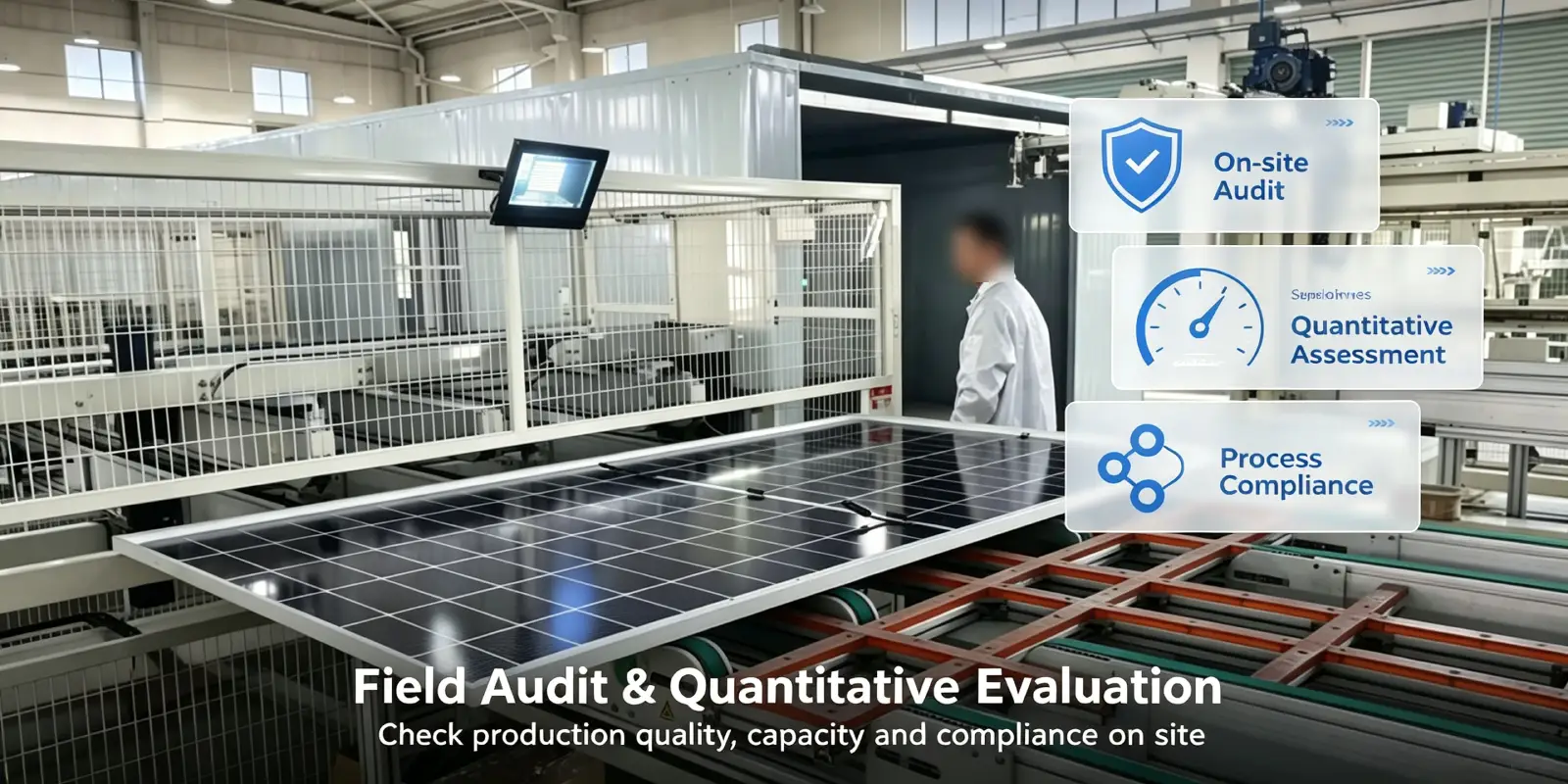
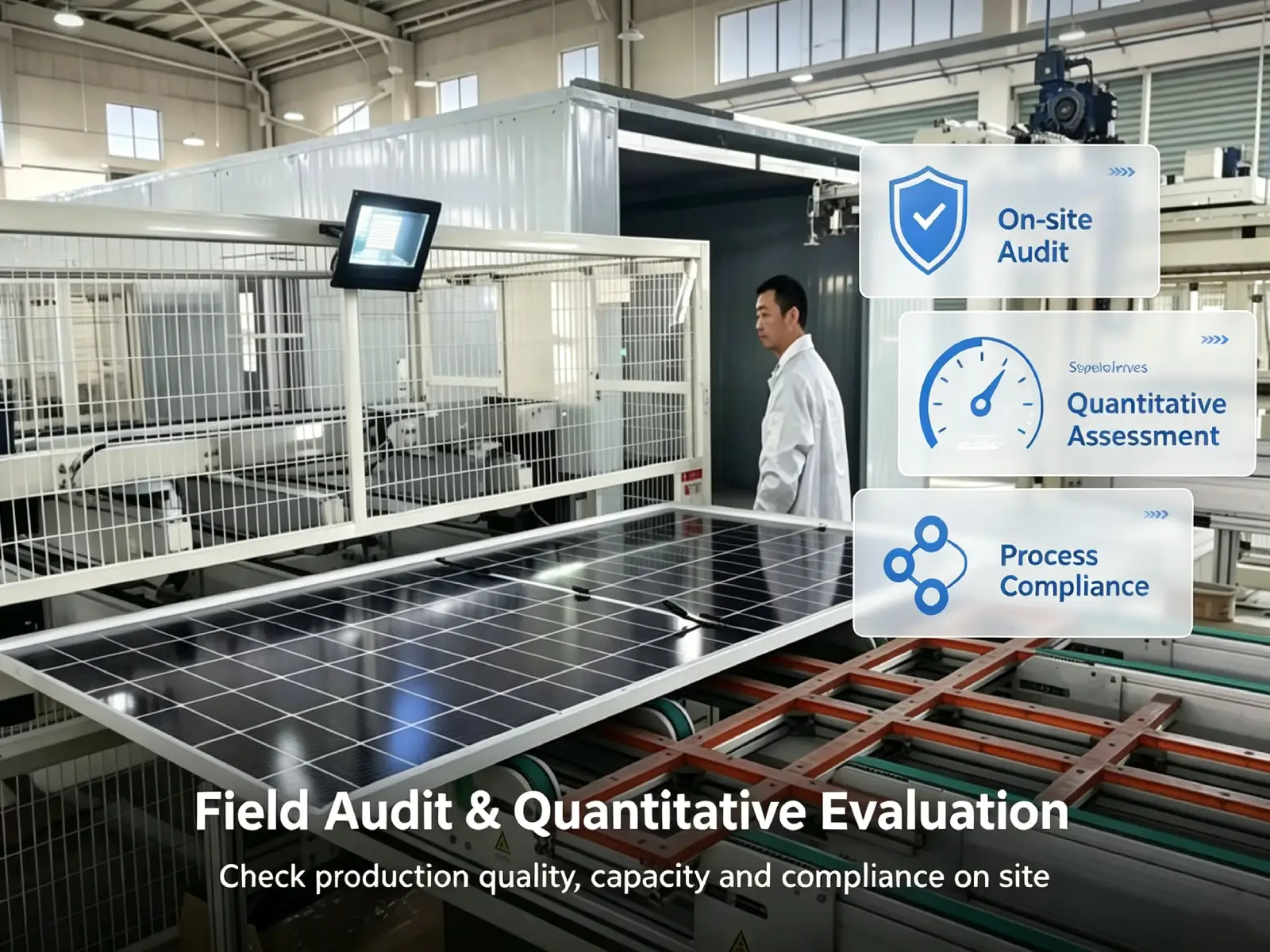
Operational metrics tell you how a supplier performs. A factory audit tells you whether they’re actually a manufacturer or just a trading company with a nice website. Here’s the checklist.
Step 1: Verify the Business License
This is the cheapest verification step and the most commonly skipped. What to check: Company name matches across business license, bank account, and contract Registration date (anything under 3 years for a supplier claiming 17 years of experience is a red flag) Registered capital (below ¥5 million is suspicious for a solar panel factory) Business scope includes PV module manufacturing or solar cell assembly Unified Social Credit Code verified on https://gsxt.gov.cn/ Pro tip: If a solar panel supplier refuses to provide a business license for “confidentiality reasons,” walk away. Real factories provide it within 24 hours.
Step 2: Confirm Actual Production Capacity
Capacity claims are the most exaggerated numbers in the solar industry. A factory claiming “20 GW annual capacity” might actually produce 2 GW—and they’ll still quote based on the 20 GW number. How to verify: Ask for production line counts and cell-to-module integration. A real 5 GW factory needs at least 4-6 stringers, 8-10 laminators, and matching capacity at each process step Request recent production records—monthly output reports, electricity bills (power is a major cost—a 5 GW factory spends $1-3M per month on electricity), or shipment lists Check BloombergNEF, Wood Mackenzie, or InfoLink Tier 1 manufacturer lists for independent capacity benchmarks Confirm vertical integration for cell production. Pure module assemblers buying cells from third parties are subject to cell supply constraints—a major risk to delivery schedules Benchmark: A real 5 GW factory needs 80,000-150,000 m² of production space. A real 10 GW factory needs 200,000+ m². If they claim massive capacity but offer a tour of a small building, the numbers are wrong.
Step 3: Verify Certifications
Certifications are easy to fake on a website. They’re harder to fake in the issuing body’s database. Verification checklist: TÜV Rheinland / TÜV SÜD / Intertek certificates—verify on the certification body’s official database ( https://tuv.com/ or https://intertek.com/ ). Certificate holder name and product model must match exactly IEC 61215 / IEC 61730—issued by TÜV, VDE, or other CBTL-accredited labs. Check the issuing lab’s website UL 61730 (US market)—verify on UL’s Product iQ database ( https://iq.ul.com/ ) ISO 9001 / 14001 / 45001—issued by DNV, TÜV, SGS, BV, or LRQA. Verify on the certification body’s database For a detailed walkthrough on verifying each of these, see our guide: [How to Verify Solar Panel Supplier Certifications: UL, IEC, TÜV Checklist].
Step 4: Check Financial Stability
You need to know whether your solar panel supplier will still be in business when you file a warranty claim in year eight. Key indicators: Altman Z-Score: Above 2.6 is safe. Below 1.8 is distress zone—high bankruptcy risk Current ratio: Should exceed 1.2 (current assets ÷ current liabilities) Debt-to-equity ratio: Should be below 2.0 for stability Documents to request: Three years of audited financial statements (for large orders) Bank reference letters Credit reports from Chinese agencies Warranty insurance or bank guarantee documentation
Red Flags That Should Eliminate a Solar Panel Supplier
Before you invest time in price negotiation, screen for these red flags: Unusually low pricing without clear explanation. If a quote is 20% below market, something is different—older inventory, lower-grade cells, missing certifications, or a supplier who won’t be around for warranty claims. Reluctance to provide factory access. A video tour or in-person audit should be standard. Excuses about “confidentiality” are a red flag. No customer references. A solar panel supplier who can’t provide references is either new or has something to hide. Requests for full payment upfront. Standard terms involve a deposit and balance. Full upfront payment without an established relationship is a risk. Poor communication. If pre-sales communication is slow or unclear, post-sales support will be worse.
What to Ask Before You Sign
What’s your on-time delivery rate for the past 12 months? What’s your average response time for pre-sales and post-sales inquiries? Can you provide three customer references? Can you provide your business license and recent production records? What’s your Altman Z-Score or current ratio? Can you provide certificates for the specific model I’m buying? What happens if delivery is late? A solar panel supplier who answers all seven clearly is worth talking to. One who deflects or gives vague answers is telling you something about how they’ll handle your order.
So Is Your Solar Panel Supplier Actually Reliable?
The one whose operational metrics match your project requirements. A solar panel supplier with a 100% on-time delivery rate and a 2-hour response time might not be the cheapest. But when your installation window is tight and your customer is waiting, those metrics are worth more than a few cents per watt. This is the operational layer of the procurement framework we laid out in the Wholesale Solar Panels: A Complete Procurement Guide for Distributors and EPCs. Get this right, and you’ll avoid the suppliers who look good on paper but fail in execution. Know the numbers. Do the audit. Then negotiate.
About Gaotu Innovation
Gaotu Innovation (Shenzhen) New Energy Group is a solar manufacturer with 18 years of OEM/ODM experience. We operate three manufacturing centers in Dongguan and Indonesia, with over 1 GW annual capacity and 380 global patents. Our products carry IEC, UL, CE, TÜV, and RoHS certifications, and we serve distributors and EPCs across North America, Europe, Japan, Korea, and Australia. Have a specific procurement scenario? Reach us at mailto: info@gt-pow.com or visit www.gtpowsolar.com.
Related Posts

Custom Solar Panels for RV, Marine & Yacht Projects: Sourcing Guide
Executive Summary: For fleet retrofitters, RV modification contractors, and marine equipment distributors, standard solar hardware…
How to Choose Wholesale Solar Panels in China? Practical Review & Buying Guide
Don’t Only Focus on Low Prices in Solar Panel Wholesale Finding reliable wholesale solar panels in…
Solar Panel and Portable Power Station Compatibility Guide
Core Overview: Most issues of incompatibility, charging failure, slow charging, and equipment burnout between solar…


Leave a Reply