

Solar Power Knowledge
Private Label Solar Panels for Home: What Resellers Can and Cannot Brand
 Gaotu Innovation
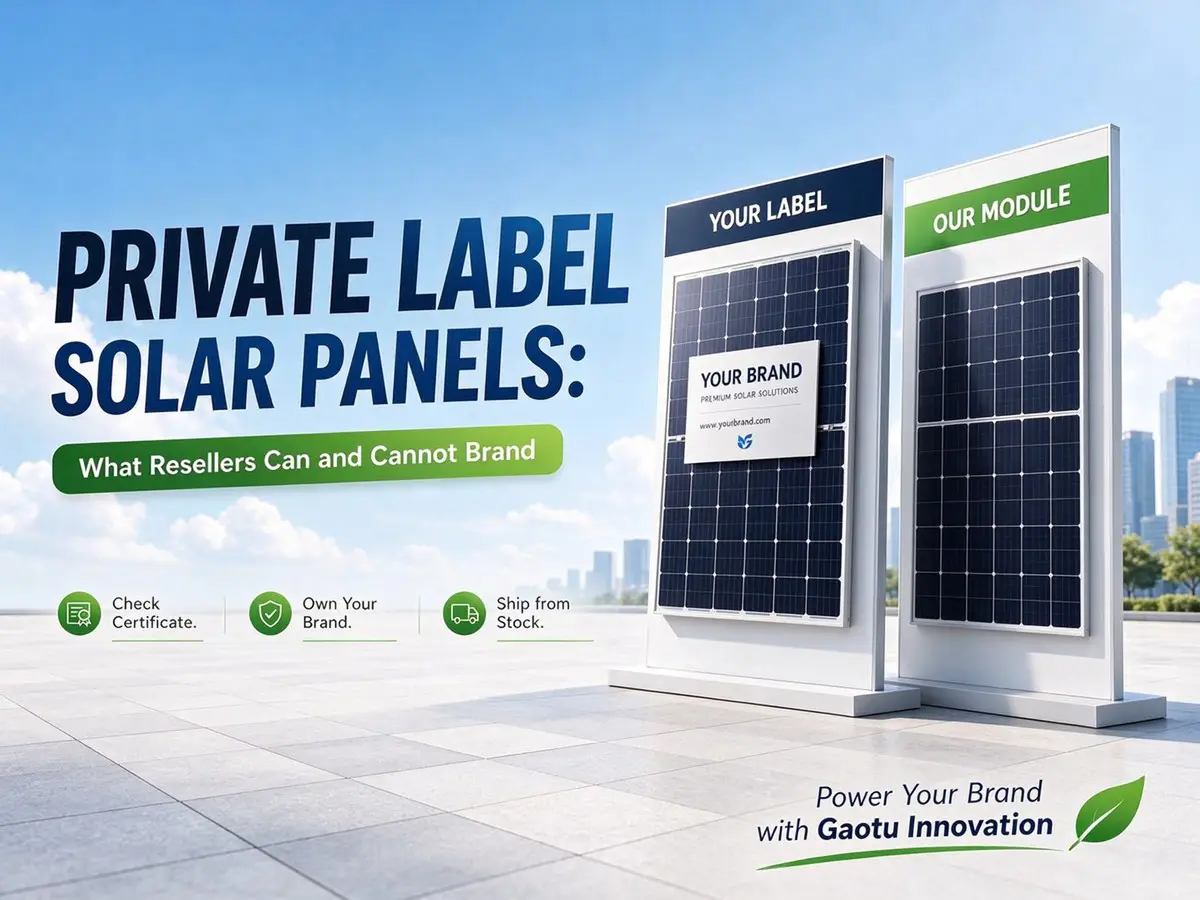
A private label residential module is not a new product — it is an existing certified module wearing your name. That distinction decides everything: which documents you can hold, which specifications you can change, what the MOQ really is, and who answers the phone when a homeowner files a claim in year seven. This guide sets out the four elements you can brand, the parts that stay with the factory, and the paperwork to settle before the first label proof is approved.
- You brand the identity, not the engineering. Label, packaging, manual, warranty wording and model designation change; cells, bill of materials and the certified configuration do not.
- The certificate stays with the factory. A private label brand is almost never the certificate holder — you receive a letter of authorization naming your model, which is what your importer and customs broker will ask for.
- Changing a model number is a compliance event, not a design decision. If the factory’s listing names a model, your new name has to be tied back to it in the file, or the module is uncertified in that market.
- Private label MOQ is usually driven by packaging, not by modules. Cartons, master cartons and printed manuals carry real setup costs; the label itself is cheap.
Four Terms That Get Used Interchangeably and Should Not Be
Sellers mix these up constantly, and the mix-up shows up later in a compliance audit or a warranty dispute.
| Term | What actually happens | Who owns the design |
|---|---|---|
| Private label | Existing module, your brand on label and packaging | Factory |
| OEM | Built to your specification — you supply drawings, the factory manufactures | You |
| ODM | Factory’s mature design, customised for your brand | Factory, licensed to you |
| White label | Marketing word for private label, usually with less customization | Factory |
Very few residential resellers actually need OEM. A new frame profile, junction box or cell layout means a new certified configuration, months of retesting and a tooling bill. What most distributors want is closer to ODM: a proven rooftop or balcony product, relabelled and repackaged, with a handful of cosmetic and documentation changes. Our residential module range is structured so that a 400–580 W rooftop platform can be branded without touching the electrical design.
The Four Things You Can Brand
- The module label. Brand name, model designation, serial number format, barcode. This is the cheapest and fastest element — artwork in days, not weeks.
- Packaging. Carton print, master carton, pallet wrap, corner protectors, pallet label with your handling instructions. This is where setup cost and MOQ live.
- Documentation. Installation manual, warranty statement, datasheet, declaration of conformity annex. These are the documents your installer customers actually hand to a homeowner.
- The model number and the story around it. A branded model name lets you build a product line, a landing page and a price ladder instead of reselling a catalogue item.
What stays unchanged: cell supplier and binning, glass and encapsulant, frame dimensions, junction box rating, connector type, flash-test data and the certified bill of materials. Any change to that list is a different product, with different test reports and a different listing.
Certificate Ownership: The Question Nobody Asks First
Certificates for a residential module are issued to the manufacturer, for a specific factory and a specific model. A private label brand cannot hold them, and should not pretend to. What you can obtain is a letter of authorization from the certificate holder permitting your brand name on the module, plus a mapping from your model designation back to the listed model. Your importer, your customs broker and a serious installer will all eventually ask for that mapping.
Three practical consequences:
- Your datasheet must carry the underlying certified model reference somewhere, even in small print. Removing every trace of the factory is how brands end up with modules that cannot clear customs.
- If the factory changes cell supplier or encapsulant after your label is approved, your branded product changes too. Put a written notification obligation into the contract.
- Serial numbers must map back to the factory’s production records, or the warranty you sell cannot be administered. A branded serial without a factory-side database is a promise with no ledger.
The full document set for EU and US import is set out in our guide to certifications for wholesale residential modules — read it before you approve artwork, not after.
What Private Label Actually Costs
| Element | Setup | Where it drives MOQ |
|---|---|---|
| Label / laser marking | Artwork proof, usually a few days | Almost none — applies from a single pallet |
| Printed carton / master carton | Printing plates, minimum run quantity | Commonly tied to a partial or full container |
| Manual and warranty booklet | Design, translation, print run | Set by print quantity, not modules |
| New frame, junction box, cell layout | Tooling, new test reports, new listing | Container-scale commitment and months of lead time |
For a first private label run, the realistic shape is a mixed container: two or three wattages under one brand, standard cartons with a branded sticker and a printed manual insert, and the carton print deferred until volume justifies the plates. That gets your name into the market without paying a full packaging tooling bill before you know whether the line sells. Our guide to MOQ for wholesale home solar panels explains how to structure that first order.
Who Answers the Warranty Claim
This is the part private label brands underestimate. Your label is on the module, so your customer calls you. The factory’s obligation to you is a separate contract. Unless those two documents are aligned, you are personally exposed for twenty-five years.
Set three things in writing before the first shipment:
- Back-to-back terms. Your published warranty to the end customer must be no longer and no broader than what the factory grants you. If you promise 25 years and your supplier gives 12, the gap is your liability.
- Claim handling path. Who inspects, who decides, who ships the replacement, and who pays the freight each way. A private label brand that cannot obtain a replacement module quickly will absorb the cost locally.
- Serial traceability. The factory must be able to look up your branded serial and confirm production date, flash data and test record. Without it, every claim becomes a negotiation.
The clauses worth negotiating are covered in our warranty terms guide for bulk home solar panels, including the replacement freight question that decides whether a small claim is worth filing at all.
What to Prepare Before the First Label Proof
- Vector artwork — logo in AI or EPS, single colour preferred for laser marking, plus a clear-space rule.
- Brand guidelines — colour codes, typography, and the exact wording you want on the label and carton.
- Barcode and GTIN — if you sell through marketplaces, a retail barcode on the carton changes the packaging spec.
- Importer of record details — legal name, address, and the market you are clearing into, so the label carries the right responsible-party text.
- Model naming scheme — decide now whether wattages differ by suffix, because retail listings, warranties and spare-part records all key off it.
- Target market documents — the language of the manual, the conformity annex, and any local labelling requirement.
Five Mistakes That Cost Real Money
- Erasing the factory entirely. Customs and certification bodies trace a module back to a listed model and factory. Keep the reference.
- Changing the bill of materials quietly. A new cell supplier at the same wattage is a different product. Require written notice.
- Branded packaging that does not match the label. Different model designation on carton and module is a classic audit finding.
- Warranty longer than the back-to-back term. The gap becomes your liability, and it surfaces exactly when volumes are highest.
- No serial database. A branded serial with no factory record means unverifiable claims for the next two decades.
Frequently Asked Questions
Can I put my brand on a solar panel that is already certified?
Yes, with the certificate holder’s written authorization and a mapping from your model designation to the listed model. The certificate itself remains in the factory’s name.
How long does a private label run take?
Label and manual artwork typically clear in weeks; printed cartons add a printing cycle. Production then follows the normal module lead time. Tooling changes to frame or junction box are measured in months, not weeks.
What is the minimum order for private label panels?
Driven by packaging, not by modules. Sticker labels can start far below a container; printed cartons usually require a partial or full container. Ask for the cost curve at two or three volumes rather than a single number.
Do I become the manufacturer of record?
No. You become the brand owner. Manufacturing responsibility, certification and factory audit obligations stay with the producer, and your contract should say so explicitly.
Can the same module be private labelled for two different brands?
Yes, and it usually is. That makes exclusivity a commercial question rather than a technical one — ask for territory and channel protection in writing if your brand is meant to be differentiated.
Certification rules, authorization requirements and packaging minimums vary by market and by product platform. The figures above describe typical practice, not a quotation. Confirm the applicable listing and document set for your destination before approving artwork.
Running a private label line and need artwork, model naming and a cost curve at two volumes? Send your brand guide and target market — our OEM team will return a packaging and certification plan. Talk to the GTPOW OEM team.
Related Posts

OEM Solar Panel Manufacturer Checklist: 12 Questions Before You Sign
Article Summary Signing an OEM contract with a solar panel manufacturer is a one-shot game:…
Warranty Terms for Bulk Home Solar Panels: What to Check Before You Sign
Commercial Terms · Warranty A 25-year performance warranty is easy to print and hard…
Custom Logo Portable Solar Panel: How Distributors Build Branded Solar Products
Article Summary This guide is for distributors who are tired of selling the same generic…



Leave a Reply