

Solar Power Knowledge
Shipping and Lead Times for Wholesale Solar Panels from China
 gaotu
gaotuCore Summary
Quick Answers
How long does production take for wholesale solar panels?
Samples: 3-7 days. Small batch (100-500 panels): 7-10 days. Standard mass production (1,000+ panels): 18-25 days. OEM/ODM with custom tooling: 45-60 days.
How long does ocean freight take from China?
To US West Coast: 2-4 weeks. To US East Coast: 4-6 weeks. To Europe: 4-6 weeks. To Australia: 3-5 weeks. Add 1-2 weeks for customs clearance and inland transport.
What’s the total lead time from order to delivery?
For a standard order to the US: 5-8 weeks total. For Europe: 6-10 weeks. For Australia: 5-8 weeks. Peak season (Chinese New Year, Q4) can add 2-3 weeks.
Should I choose Ex-works, FOB, or DDP?
Ex-works is cheapest on paper but you manage everything. FOB is the middle ground—supplier handles export, you handle freight and import. DDP is door-to-door—you pay more but don’t manage logistics. For first orders, DDP reduces risk.
When should I place my order?
Work backwards from your installation date. If you need panels on-site by June 1, place your order by early April at the latest. For peak season, add 3-4 weeks.
Let’s talk about the part of procurement that nobody wants to think about until it’s too late.
Lead time.
You find the right panel. You negotiate a good price. You sign the contract. And then you wait.
And wait.
And then the installation crew is on site, the project manager is asking where the panels are, and your container is still sitting at the port because customs flagged the paperwork.
This is the most preventable category of procurement disaster. And it happens because most buyers treat lead time as a single number—“six weeks”—instead of a sequence of stages, each with its own variables.
Here’s what actually happens between “order placed” and “panels on site.”
The Real Timeline: From Order to Delivery
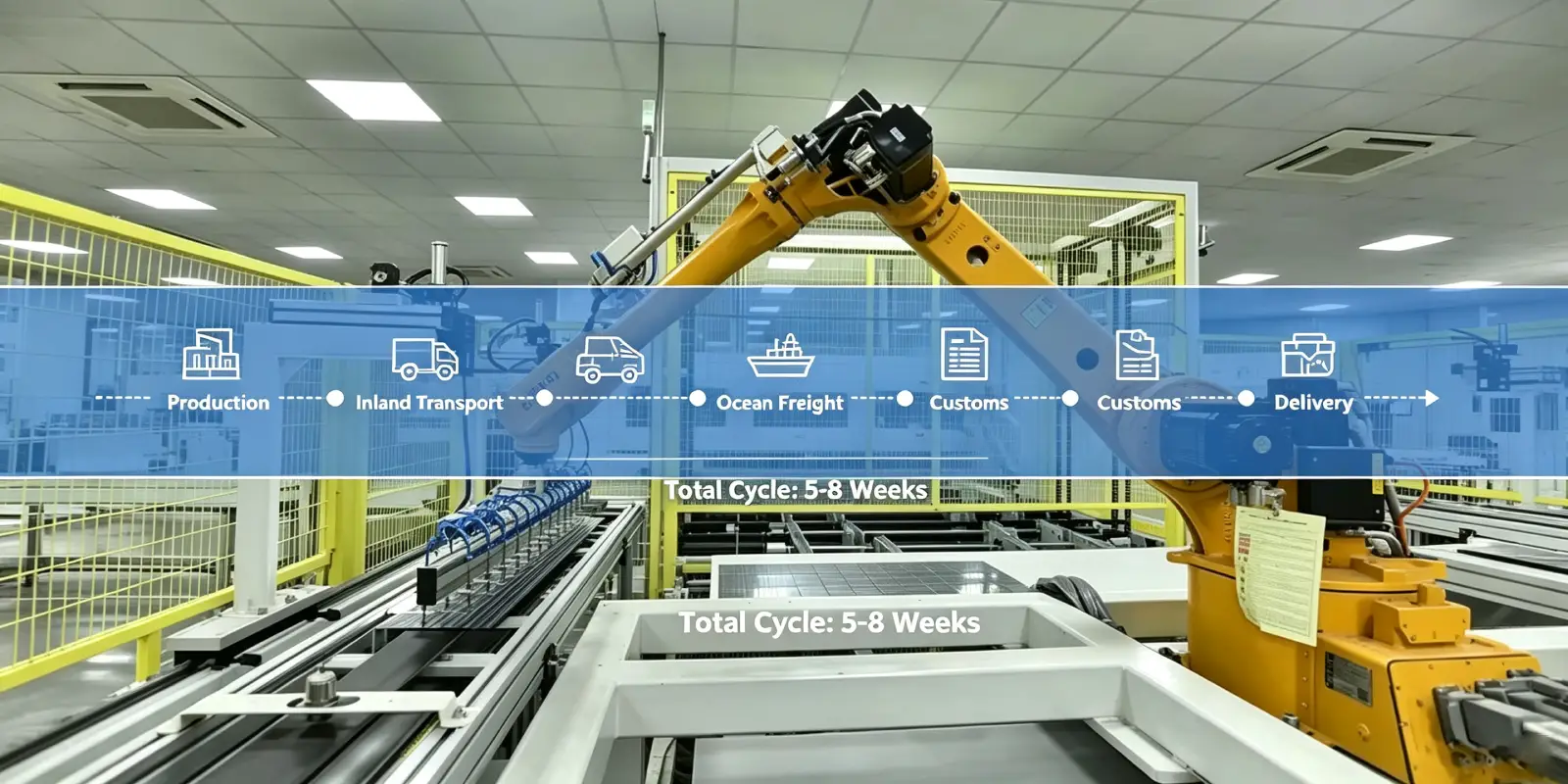
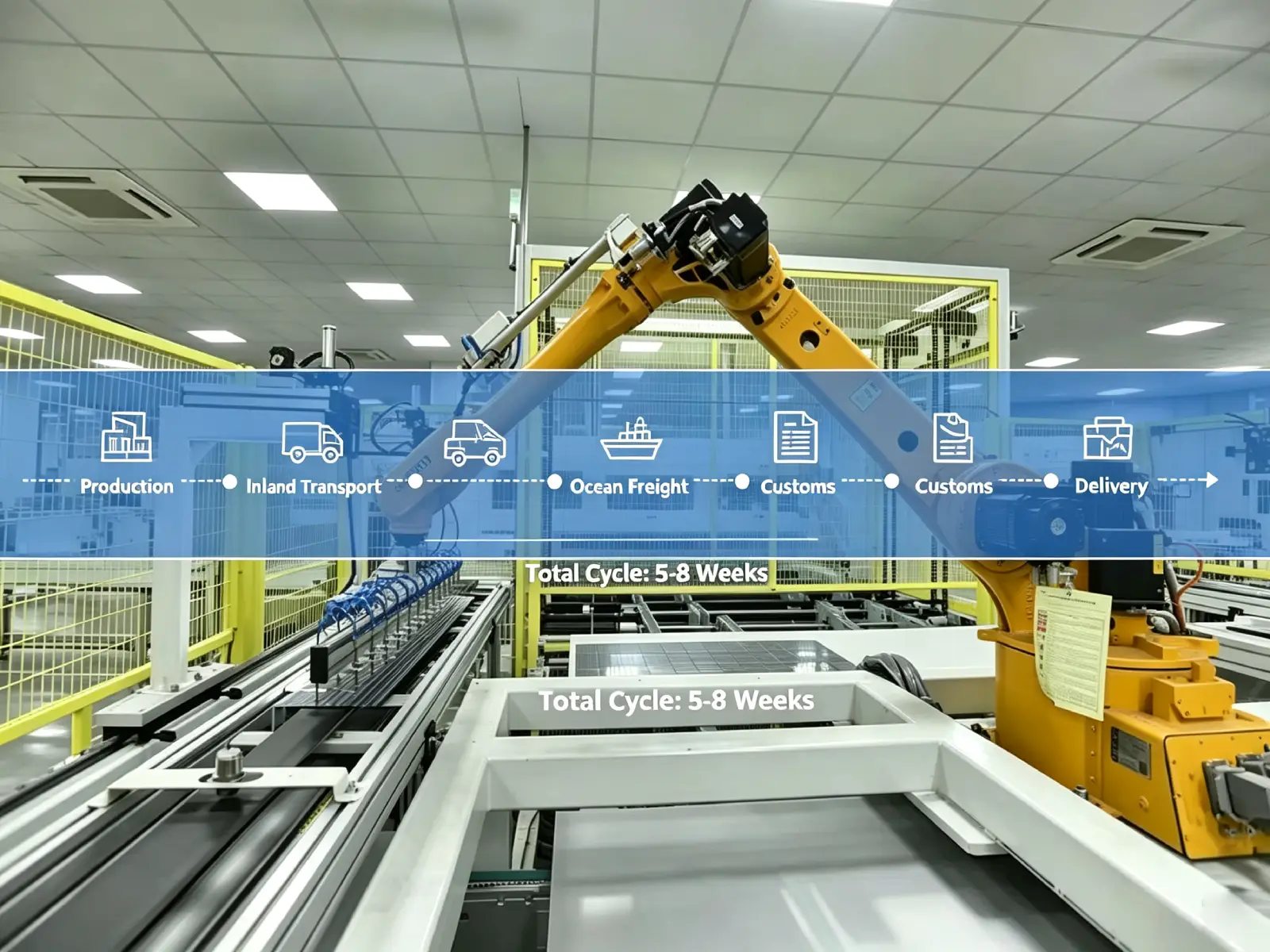
Lead time isn’t one number. It’s five stages stacked on top of each other.
Stage 1: Production Stage 2: Inland transport to port Stage 3: Ocean freight Stage 4: Customs clearance Stage 5: Inland transport to your site
Each stage has its own timeline, and each can go wrong. Let’s break them down.
Stage 1: Production Lead Time
This depends on order size and whether you’re buying standard or custom.
| Order Type | Typical Lead Time |
| Samples | 3-7 days |
| Small batch (100-500 panels) | 7-10 days |
| Standard mass production (1,000+ panels) | 18-25 days |
| OEM/ODM with custom tooling | 45-60 days |
What affects production time:
- Raw material availability. If the factory has cells, glass, and frames in stock, production starts immediately. If they need to order materials, add 1-2 weeks.
- Production line scheduling. A factory running at full capacity may not be able to start your order immediately. Ask about their current queue.
- Customization. Standard panels with standard labeling ship faster. Custom frame colors, junction box configurations, or cell layouts add time.
- Chinese New Year. This is the big one. Factories shut down for 2-4 weeks around Chinese New Year (late January or February, depending on the year). Orders placed in December or January face significant delays. Plan around it.
Stage 2: Inland Transport to Port
From the factory to the departure port. This is usually 1-3 days for factories in Guangdong or Jiangsu provinces.
What can go wrong: Truck shortages during peak season, port congestion, or documentation issues that delay container loading.
Stage 3: Ocean Freight
This is the longest stage and the most variable.
| Route | Transit Time |
| China → US West Coast | 2-4 weeks |
| China → US East Coast | 4-6 weeks |
| China → Europe (Rotterdam/Hamburg) | 4-6 weeks |
| China → Australia | 3-5 weeks |
| China → Southeast Asia | 1-2 weeks |
What affects ocean freight time:
- Port congestion. Los Angeles/Long Beach, Rotterdam, and Sydney can have significant backlogs during peak season.
- Route disruptions. Red Sea diversions, Panama Canal restrictions, and other geopolitical factors can add weeks to transit times.
- Carrier schedules. Some routes have weekly sailings; others have less frequent schedules. Missing a sailing can add a week.
- Peak season surcharges. Q3 and Q4 are peak shipping seasons. Rates go up, and space gets tight.
Stage 4: Customs Clearance
This is where paperwork problems become expensive problems.
Typical clearance time: 1-3 days if documents are in order. 1-2 weeks if they’re not.
What’s needed:
- Commercial invoice
- Packing list
- Bill of lading
- Certificate of origin
- Product certifications (IEC, UL, etc., depending on market)
- HS codes correctly classified
What goes wrong:
- HS code misclassification triggers inspection
- Missing certifications hold the shipment
- Antidumping or countervailing duty (AD/CVD) issues on solar products
- Section 232 tariffs (US market) adding cost and delay
Stage 5: Inland Transport to Site
From the port to your warehouse or project site. Usually 1-5 days, depending on distance.
What can go wrong: Trucking shortages, delivery appointment backlogs, or site access issues.
Total Lead Time: The Real Numbers
Add it all up:
| Destination | Realistic Total Lead Time |
| US West Coast | 5-8 weeks |
| US East Coast | 7-10 weeks |
| Europe | 6-10 weeks |
| Australia | 5-8 weeks |
| Southeast Asia | 3-6 weeks |
Add 2-3 weeks for:
- Chinese New Year period
- Q4 peak season
- Custom or OEM orders
- First-time supplier relationships
Incoterms: Who Manages What
This is where a lot of buyers get confused. The price you negotiate depends on which Incoterm you use.
- Ex-works (EXW) You pick up from the factory. You handle everything: inland transport, export clearance, ocean freight, import clearance, and final delivery. Cheapest on paper, most work for you.
- FOB (Free On Board) Supplier handles export clearance and loading onto the vessel. You handle ocean freight, insurance, import clearance, and final delivery. This is the most common term for wholesale solar panels.
- CIF (Cost, Insurance, Freight) Supplier handles export clearance and ocean freight to your destination port. You handle import clearance and final delivery. Good middle ground.
- DDP (Delivered Duty Paid) Supplier handles everything, door-to-door. You pay more, but you don’t manage logistics. Best for first orders or if you don’t have a freight forwarder.
Which should you choose?
- If you have a reliable freight forwarder: FOB or CIF
- If you’re new to importing: DDP
- If you have volume and logistics expertise: EXW
Peak Season Bottlenecks
Some times of year are worse than others. Plan around them.
- Chinese New Year (January/February) Factories close for 2-4 weeks. Workers travel home. Production stops. Orders placed in December or January face significant delays. Place orders by November if you need delivery before March.
- Q4 Peak Season (October-December) Ocean freight rates spike. Container space gets tight. Ports get congested. If you need panels before year-end, book early.
- Golden Week (October 1-7) Chinese national holiday. Factories slow down or stop for a week. Plan around it.
- Ramadan (varies) If your supplier has Muslim-majority workforce (like Indonesia), production may slow during Ramadan.
How to Build a Delivery Schedule That Holds
Step 1: Work backwards from your installation date Determine the latest date you can receive panels without delaying installation. Then subtract:
- Inland transport: 1-5 days
- Customs clearance: 1-3 days
- Ocean freight: 2-6 weeks
- Inland transport to port: 1-3 days
- Production: 7-25 days
Step 2: Add buffer Add 2-3 weeks for unexpected delays. If your calculation says you need to order by April 1, order by March 15.
Step 3: Confirm production start date Don’t just ask “what’s your lead time.” Ask “when can you start production?” A supplier with a 20-day lead time might not start for 10 days if their line is full.
Step 4: Get milestone updates Ask for production milestone updates: material arrival, production start, production complete, container loaded, vessel departed. This lets you catch delays early.
Step 5: Verify shipping documentation Before the container leaves, verify all documents: invoice, packing list, bill of lading, certificates. Errors here cause customs delays.
What to Ask Before You Order
- What’s your current production queue? When can you start my order?
- What’s the production lead time for my order size?
- Which port will you ship from?
- What Incoterm are you quoting?
- What’s the estimated ocean freight transit time?
- Can you provide milestone updates during production?
- What happens if delivery is delayed?
A supplier who answers all seven clearly is worth talking to. One who deflects or gives vague answers is telling you something about how they’ll handle your order.
Final Thought
Lead time isn’t a number. It’s a schedule. And schedules are managed, not hoped for.
The buyers who get panels on time aren’t the ones who found the fastest supplier. They’re the ones who planned backwards from their installation date, added buffer, and tracked milestones along the way.
This is the logistics layer of the procurement framework we laid out in the Wholesale Solar Panels: A Complete Procurement Guide for Distributors and EPCs. Get this right, and you’ll avoid the most preventable category of procurement disaster.
Plan backwards. Add buffer. Track milestones. Then order.
About Gaotu Innovation
Gaotu Innovation (Shenzhen) New Energy Group is a solar manufacturer with 18 years of OEM/ODM experience. We operate three manufacturing centers in Dongguan and Indonesia, with over 1 GW annual capacity and 380 global patents. Our products carry IEC, UL, CE, TÜV, and RoHS certifications, and we serve distributors and EPCs across North America, Europe, Japan, Korea, and Australia.
Have a specific procurement scenario? Reach us at info@gt-pow.com or visit www.gtpowsolar.com
Related Posts
OEM Solar Panels Specs Guide
If you’re a solar wholesaler, importer or distributor sourcing OEM solar panels, understanding every key…

How to Find Reliable Flexible Solar Panel Wholesale Supplier
Flexible solar panels have become one of the fastest-growing renewable energy products for off-grid applications,…
How to Choose a Reliable Flexible Solar Panel Manufacturer
1. Why Flexible Solar Sourcing Frequently Fails Flexible solar panels have evolved far beyond basic…


Leave a Reply