

Solar Power Knowledge
Bulk & Large Quantity Solar Panel Supply: MOQ, Pricing Tiers, and Lead Times Explained
 gaotu
If you are trying to figure out whether a factory can handle your order volume, what the price will be, and how soon it can ship—this article answers those three questions directly. We aren’t going to discuss the technical principles of solar panels here. We are going to break down the logistics of bulk procurement: how the tiered structure from pallet to full container works, why a higher volume doesn’t automatically mean a lower unit price, and the actual timeline milestones you need to verify behind any lead time promise.
This guide is written for B2B buyers who have already decided to purchase and are currently comparing supplier quotes. If you are still trying to figure out whether to deal with a factory or a trading company, we recommend reading our pillar article, Solar Panel Wholesale Supplier Guide: How to Source Bulk Supply Direct from a Factory.
Pallets, Full Containers, and MOQ: How Bulk is Actually Tiered
The standard units for solar module bulk orders aren’t “pieces”—they are “pallets” and “containers.” Understanding this tiered structure is the first step in judging whether a supplier’s quote is reasonable.
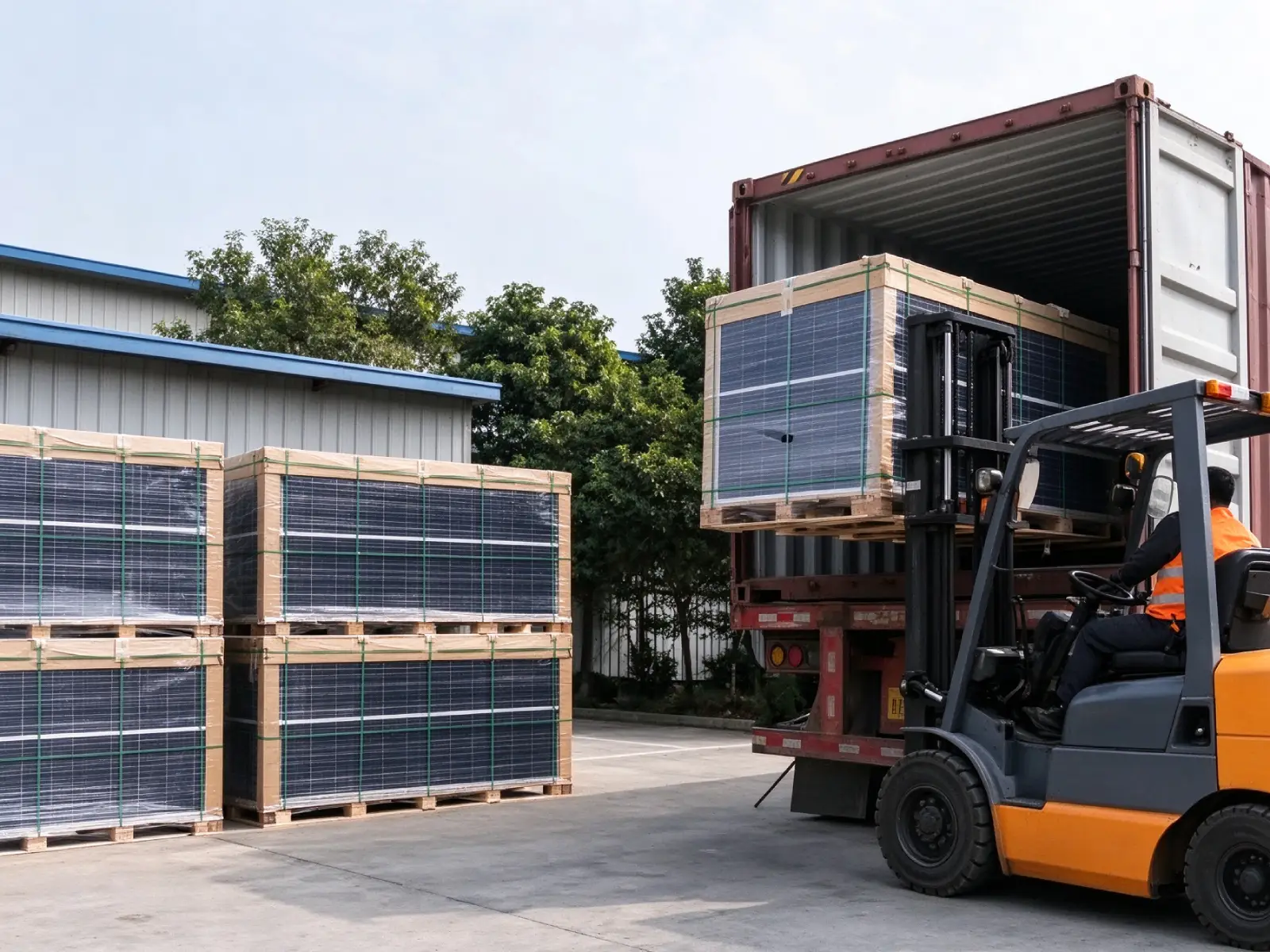
Pallet-level is your entry-level bulk option below full-container volume. A standard pallet typically holds 30 to 36 modules, depending on module dimensions and frame thickness. According to standard packaging specs from many suppliers, a pallet can hold 30 modules for 1640mm sizes (without small packages) or 34 modules (with small packages). For larger 1957mm modules, the pallet count drops to 21 to 27 pieces. Pallet-level purchasing is ideal for trial orders after sample validation or for small batch stockpiling in the early stages of a project.
Full-container level is the true starting point for bulk procurement. The loading capacity of a 40-foot High Cube (40HQ) varies significantly based on module power and size. For example, 600W modules can fit roughly 720 pieces, and 640W TOPCon modules hold around the same. However, 700W+ bifacial modules drop to about 612 pieces due to their wider dimensions. In terms of capacity, a 40HQ typically holds between 430kW and 461kW of modules. This means when you request a quote for “one container,” the unit price you get corresponds to a procurement volume in the hundreds of kilowatts.
MOQ settings are directly tied to this tiering. The MOQ for a pallet-level order is usually around 30 pieces, while full-container orders are based on the capacity of a 40HQ. Orders below pallet level (e.g., a few pieces to a dozen) are usually treated as sample orders by factories, and the unit price is not representative of bulk pricing. If you see a supplier offering an incredibly low “wholesale price” with an MOQ of just a few pieces, you need to confirm whether that price applies to standard in-stock items or is just a lead-generation tactic.
Pricing Tiers: Why Higher Volume Doesn’t Automatically Mean a Lower Price
A common misconception in bulk procurement is that doubling your order volume should result in a linear drop in unit price. The reality is much more complex.
The real sources of downward price pressure come from three things: reduced production line changeover frequency, spreading packaging and logistics costs, and better payment terms on raw material procurement. If a factory is already running a continuous production batch of the specification you need, inserting your order incurs almost no extra changeover cost, giving you the most room to negotiate. Conversely, if your power band or dimensions require a dedicated production run and special material procurement, the factory may quote a higher unit price even at full-container volumes to cover the changeover loss.
The current market pricing environment adds another layer of complexity. As of October 2026, the average price for utility-scale TOPCon 210 bifacial modules is around RMB 0.700/W, and rectangular bifacial modules are around RMB 0.690/W. However, this price level is significantly affected by silver paste cost fluctuations. During the silver price surge in early 2026, the tax-inclusive full cost of TOPCon modules at peak silver prices could reach RMB 0.866/W. This means quote validity periods are shorter than ever. When requesting a quote, confirming the silver price baseline and expiration date is more meaningful than just comparing the final number.
Practical advice: When sending a request for quotation (RFQ), ask what specifications the factory is currently running in volume before naming your target quantity. If their current production specs closely match your needs, you’ll get a much more competitive quote. If your needs deviate far from their current runs, understanding the changeover cost upfront will help you determine if the premium is reasonable.
Lead Times: Break It Down into Five Phases, Not Just One Number
When a supplier says “25-day delivery,” that number usually only covers the production phase. The actual time to delivery is a sum of five phases, each with its own risk points.
Phase 1: Production. Standard products with raw materials in stock typically take 18 to 25 days for mass production orders of 1,000+ pieces. Small batches (100–500 pieces) can be shortened to 7–10 days. OEM/ODM orders requiring new molds or special structures can take 45–60 days. Variables affecting production time include raw material inventory status, production line queue, and the Chinese New Year holiday (factories shut down for 2–4 weeks).
Phase 2: Inland Transport to Port. It usually takes 1–3 days from a factory in Guangdong or Jiangsu to the departure port. Peak season may bring trailer shortages or port congestion.
Phase 3: Ocean Freight. From China to the US West Coast is about 2–4 weeks, to the US East Coast 4–6 weeks, to Europe (Rotterdam/Hamburg) 4–6 weeks, and to Australia 3–5 weeks. Peak season surcharges, port congestion, and route diversions can stretch this window further.
Phase 4: Customs Clearance. Takes 1–3 days if documents are complete. Incorrect HS code classification, missing certification documents, or trade remedy measures (like AD/CVD in the US market) can cause delays of 1–2 weeks.
Phase 5: Port to Warehouse or Project Site. Usually 1–5 days, depending on distance and scheduling.
Adding these five phases together, the realistic total lead time from China to the US West Coast is 5 to 8 weeks, 7 to 10 weeks to the US East Coast, and 6 to 10 weeks to Europe. If you need the goods by a certain date, work backwards from the installation deadline and build in at least a 2-week buffer—3 to 4 weeks during peak season.
Three Overlooked Checkpoints in Bulk Procurement
Beyond price and lead time numbers, these three items directly impact the final outcome of your bulk order.
First, confirm if the container loading plan is optimized. Two different loading plans for the same 40HQ can result in drastically different space utilization. For example, a 1MW project using 600W modules requires about 1,667 pieces. At 720 pieces/container, that’s 3 containers, but the third container would only hold 227 pieces—an extremely inefficient use of space. A better approach is to adjust the module power mix: use 2 containers for 1,440 pieces of 600W modules (approx. 864kW), and fill the remaining capacity with higher-power modules. When requesting a quote, proactively provide your total project capacity and ask the supplier for a loading optimization plan, rather than simply asking for “the price of one container.”
Second, require the supplier to provide production scheduling confirmation for your batch. The credibility of a lead time promise depends on the factory’s actual current scheduling status. Ask for your order’s position in the production queue and the estimated start date. Suppliers willing to provide this information usually have a solid grasp of their capacity management. If they only reply with “we will arrange it as soon as possible,” you need to bear the lead time risk yourself.
Third, confirm payment terms and inspection arrangements simultaneously for the first order. The dollar amount of bulk orders is far higher than sample orders, and the risk of 100% upfront payment cannot be ignored. Prioritize payment channels that support escrow or letters of credit. For inspection, in addition to a pre-shipment video review of packaging and appearance, we recommend arranging for a third party to conduct spot checks before container loading for bulk orders, focusing on verifying that the power binning and EL inspection reports match the contract batch.
Next Steps
If you have determined your target power band and approximate procurement volume, the next step is to send a structured RFQ to at least two suppliers with specific specs and quantities, rather than just asking “what’s the price.” Your RFQ should include: target power and dimensions, estimated order volume (pieces or containers), target market (which affects certification and trade compliance requirements), and expected arrival date. The quality of their response and their speed of reply are screening criteria in themselves.
For a complete supplier verification framework in bulk supply, see our pillar article, Solar Panel Wholesale Supplier Guide. If you have customization requirements (OEM/ODM/White-label), our Custom Bulk Order Guide covers the thresholds and use cases for all three models.
About Gaotu Innovation
Gaotu Innovation is a solar manufacturer with 18 years of OEM/ODM experience, operating over 50,000m² of production bases globally (Dongguan main factory/branch factory and Indonesia manufacturing center), backed by 380 global patents and production lines with over 92% automation. For bulk procurement buyers, our core capabilities include: production synergy across three factory locations supporting a smooth transition from pallet-level trial orders to full-container mass production; our Indonesia manufacturing center providing an AD/CVD tariff risk mitigation option for North American clients; and our five international warehouses (US/Europe/Japan/Korea/Australia) shortening local delivery cycles. We have provided long-term OEM and joint R&D services for brands including Anker, EcoFlow, and Bluetti. To get tiered pricing and loading plans for your specific specifications and quantities, please contact us.
Related Posts

Wholesale Portable Solar Panel: The Ultimate Sourcing Guide for Bulk Buyers
Portable foldable solar panels have become one of the fastest-growing off-grid energy products globally. Demand…

How to Charge an E-Bike with Solar Panels
Never connect a solar panel directly to an e-bike battery. This will not work…
Balcony Solar Regulations in Germany & UK — A Distributor's Guide to Staying Out of Trouble (2026)
If you’re sourcing balcony solar kits for the German or UK market, getting the regulations…

Leave a Reply