

Solar Power Knowledge
What’s Actually Included in a Commercial Solar Quote (And What’s Quietly Missing)
 gaotu
gaotu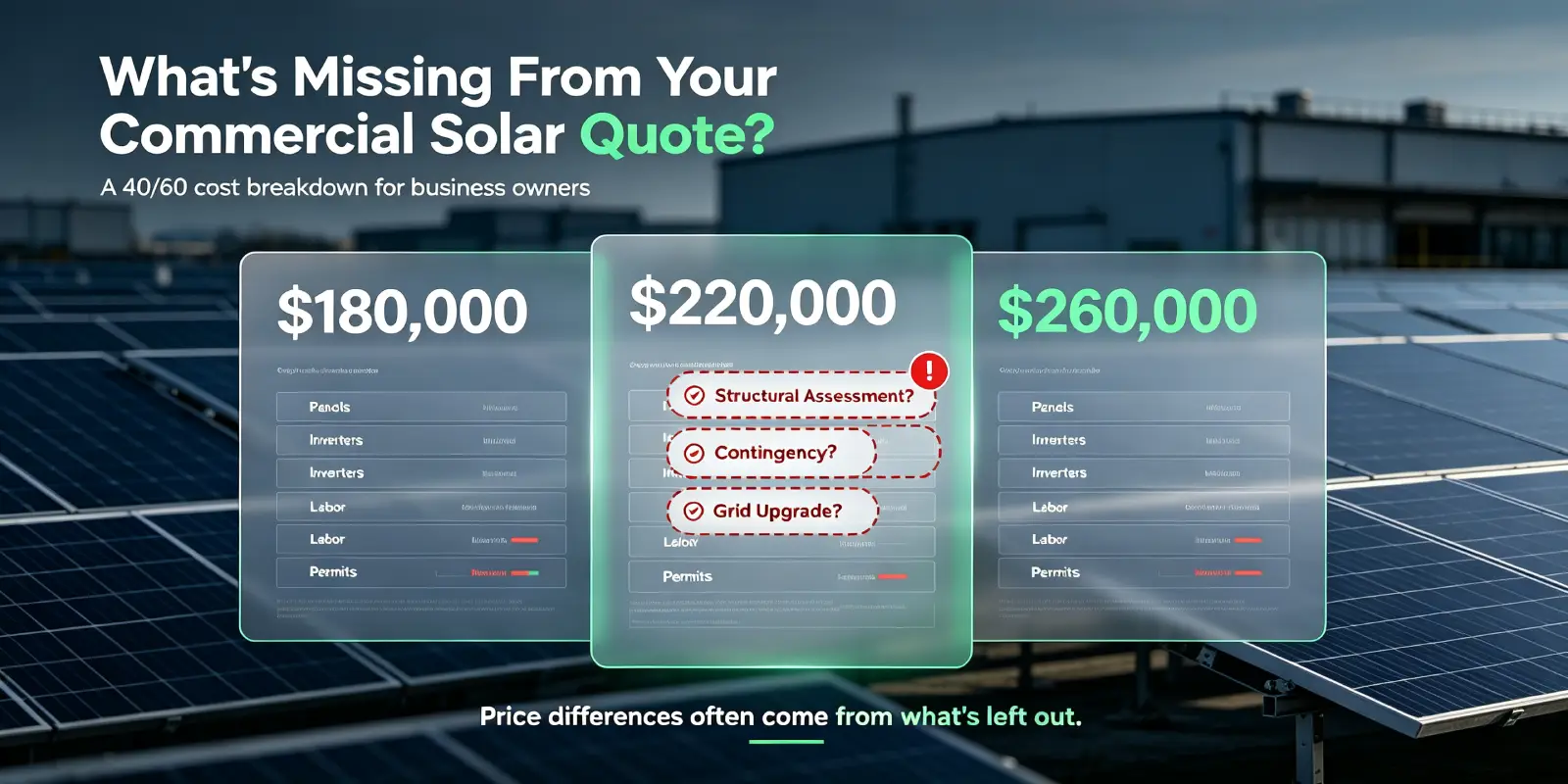
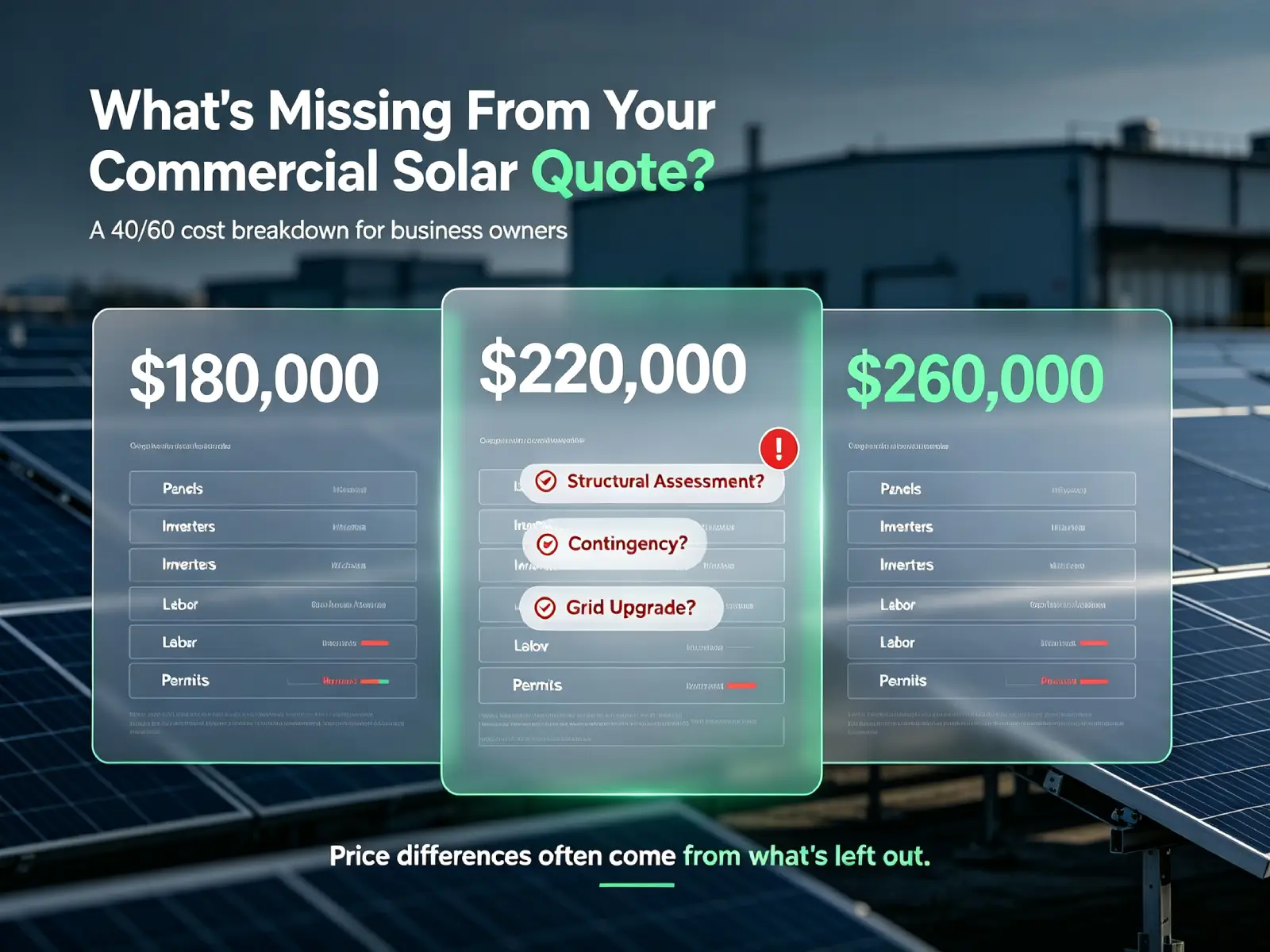
You get three quotes for the same rooftop. Same building, same 100kW, same location. One comes in at $180,000. Another at $220,000. The third at $260,000.
Your first instinct is that someone’s padding the price, or someone’s cutting corners. But the real answer is messier: each quote is answering a different question, and nobody wrote down their assumptions.
This article breaks down what a commercial solar quote should actually contain, what often gets left out, and how to compare bids without getting fooled by the bottom line. If you’re trying to understand why commercial solar quotes vary so wildly—and what to do about it—this is the guide you’ve been looking for.
Quick Answer: What Should a Commercial Solar Quote Include?
A complete commercial solar quote should list line items for structural assessment, electrical capacity check, grid interconnection scope, DC vs. AC rating, monitoring and O&M, contingency (8–12%), and warranties. If any of these are missing, ask why.
The lowest number is rarely the best deal. The highest isn’t automatically the safest. What matters is whether every bidder is pricing the same scope—and whether they’ve written down what they assumed.
The 40/60 Split Nobody Tells You About
Here’s the first thing to internalize: in a commercial project, hardware is not the majority of your cost.
Solar panels themselves are cheap now. A TOPCon module from a Tier 1 manufacturer runs around $0.11 to $0.15 per watt at the factory gate. A 100kW system needs roughly 200 modules at 550W each. That’s maybe $11,000 to $15,000 worth of panels.
But you’re not paying $15,000. You’re paying $180,000 to $280,000.
Where does the rest go? Into everything that isn’t a panel:
- Inverters: string or central, $0.05–$0.10/W
- Racking and mounting: roof-specific, $0.10–$0.20/W
- Cabling and wiring: DC and AC sides, $0.05–$0.10/W
- Switchgear and panelboards: often overlooked, $0.05–$0.15/W
- Engineering and design: structural, electrical, permitting
- Labor: installation crew, electricians, roofers
- Grid interconnection: application, studies, possible upgrades
- Commissioning and testing: the part that makes it actually work
- Permits and fees: varies wildly by jurisdiction
- Contingency: the 8–12% buffer that smart EPCs build in
A useful rule of thumb from industry cost guides: BOS (balance of system) plus soft costs account for 60% or more of a commercial project’s total price. If your quote only talks about panels, you’re not looking at a real quote.
What a Complete Commercial Solar Quote Should List
A commercial solar quote worth comparing should have line items for all of the following. If something is missing, ask why.
Structural assessment. Has a structural engineer actually reviewed the roof? Not a salesperson eyeballing it from the ground. A real structural review costs money and takes time. If it’s not in the quote, either it wasn’t done or it’s been bundled into a vague “engineering” line.
Roof condition and warranty. If your roof is within 5–7 years of needing replacement, the correct move is to replace it before installing solar. Otherwise you’ll pay to remove and reinstall the array later. A quote that ignores roof age is setting you up for a painful conversation in year six.
Electrical capacity check. Someone needs to physically open your main distribution panel and check available breaker space, busbar rating, and transformer capacity. Remote estimates based on utility bills are guesses, not assessments.
Grid interconnection scope. Who files the application? Who pays for studies? What happens if the utility requires a relay or transformer upgrade? In some jurisdictions, a single protection relay can add $30,000 to $50,000. This needs to be a named line item, not a footnote.
DC vs. AC rating. Commercial quotes should state both. A system rated at 100kW DC might deliver 80kW AC. If one bidder quotes DC and another quotes AC, you’re comparing apples to oranges. Typical DC/AC ratio for commercial is 1.2 to 1.3.
Monitoring and O&M. Who’s watching the system after commissioning? What’s the response time if an inverter goes down? Is there a performance guarantee? These aren’t optional extras for a 25-year asset.
Contingency. A serious commercial quote includes an explicit contingency line, usually 8% to 12% of project cost. If it’s absent, the contingency is either hidden in inflated line items or it doesn’t exist—meaning change orders are coming.
Warranties and performance guarantees. Panel warranties are standard (12–25 years product, 25–30 years performance). But what about workmanship? What about the EPC’s own guarantee? What happens if the company that installed your system is gone in five years?
Hidden Costs That Show Up Later
Even a detailed quote can miss things. Here are the ones that catch facility managers off guard most often.
Roof reinforcement. Older industrial buildings were not designed for the point loads and wind uplift that solar arrays create. Adding structural steel isn’t glamorous, but it’s necessary. If nobody walked the roof with a structural engineer, you don’t know if you need it.
Panel-level rapid shutdown. Some jurisdictions require module-level rapid shutdown for commercial rooftops. This adds cost per module—and if it’s not in the quote, it’ll be a change order.
Service panel upgrades. Your building may have plenty of power, but the panelboard may not have space for the solar breaker. Upgrading a service panel can run $5,000 to $15,000 depending on size and complexity.
Production metering. If you want to track actual generation separately from consumption, you need a production meter. Utilities may or may not require it. If you want it for your own reporting, it’s on you to specify it.
Insurance rider. Your property insurance will need to cover the array. That’s an ongoing cost, not a one-time one, but it should be factored into your ROI.
Inverter replacement. Inverters typically last 10–15 years, not 25. Budget for at least one replacement over the system’s life. Some quotes include an inverter replacement reserve; most don’t.
How to Compare Commercial Solar Quotes Without Getting Fooled
The lowest number is almost never the best deal. But the highest number isn’t automatically the safest bet either.
Ask each bidder: “What’s the assumption in this quote you’re least confident about?” This question separates people who walked the site from people who modeled it in front of a screen. A real installer will tell you: the remaining capacity in the panelboard, the condition of the north-side purlins, whether the utility will require a relay. A desk estimator will give you a generic answer.
Normalize the scope. Take each quote and map it against the checklist above. Mark what’s included, what’s excluded, and what’s unclear. Then compare the adjusted totals, not the headline numbers.
Look for what’s not there. Missing structural review, missing contingency, missing O&M—these aren’t savings. They’re risks you’re accepting without knowing it.
Check the EPC’s own stability. A 25-year asset installed by a company that might not exist in five years is a problem. Ask for references from projects installed 5+ years ago. Call those references. Ask if the system is performing as promised and if the EPC has been responsive.
The Bottom Line
A commercial solar quote is not a price. It’s a set of assumptions about your building, your utility, and your risk tolerance—translated into dollars.
The difference between a $180,000 quote and a $260,000 quote is rarely $80,000 of profit. It’s $80,000 of scope that one bidder included and the other didn’t.
Your job isn’t to find the cheapest number. It’s to make sure every bidder is answering the same question. And the only way to do that is to ask what they assumed—and what they left out.
Frequently Asked Questions
What is a typical commercial solar quote per watt?
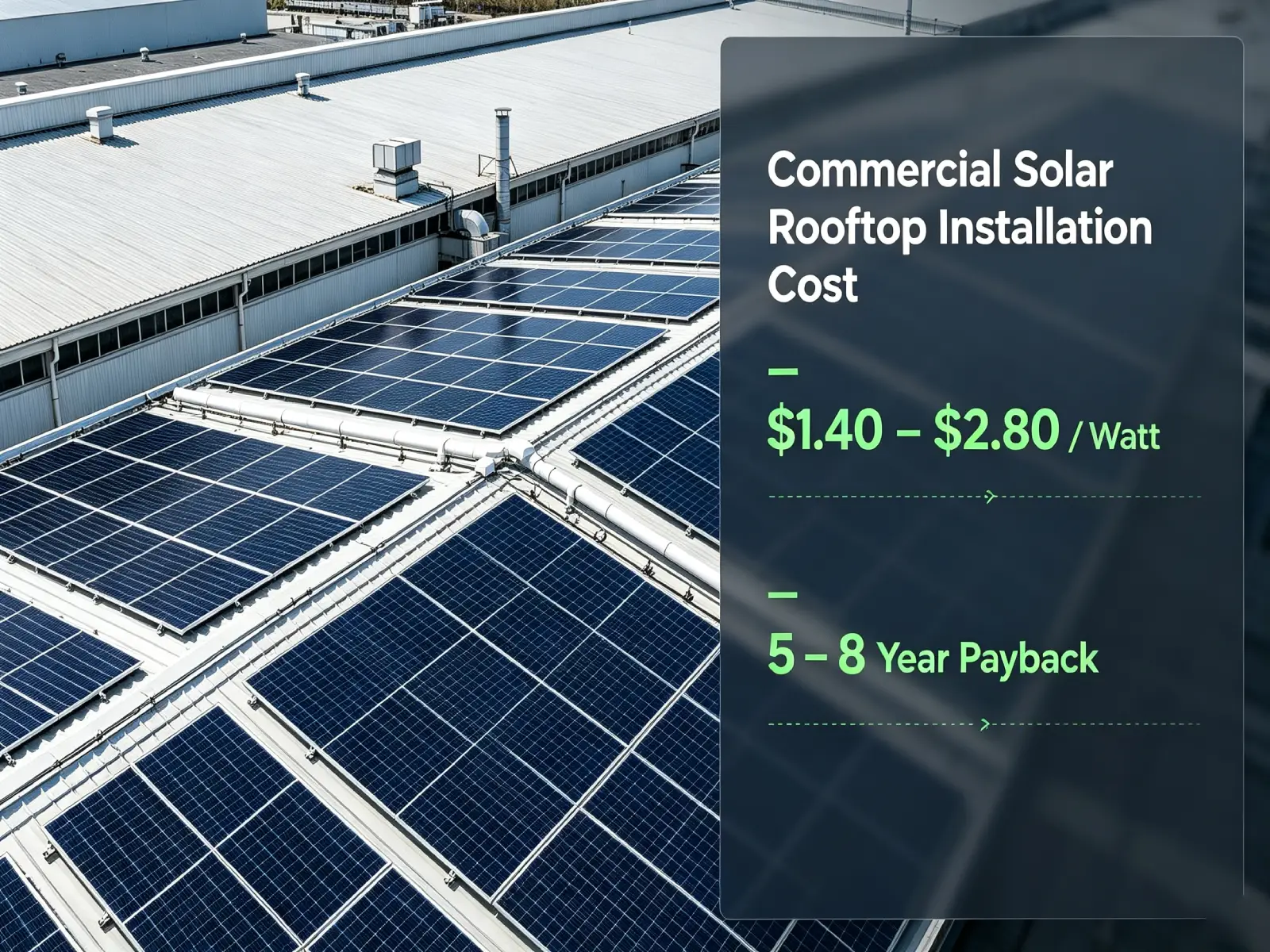
In the U.S., commercial solar installation costs range from $1.80 to $2.80 per watt in 2026, before tax credits. After the 30% ITC, net cost falls to roughly $1.26 to $1.96 per watt.
How long does a commercial solar payback period usually take?
Most commercial projects target a 5 to 8 year payback. In high-electricity-price markets with strong daytime consumption, payback can be as short as 3 to 4 years.
What’s the difference between DC and AC rating in a solar quote?
DC rating refers to the total capacity of the panels. AC rating refers to the inverter’s output. A system rated at 100kW DC might deliver 80kW AC. Always ask for both so you’re comparing the same metric.
Should I replace my roof before installing solar?
If your roof is within 5 to 7 years of needing replacement, yes. Removing and reinstalling a solar array later costs significantly more than doing the roof first.
What contingency should be included in a commercial solar quote?
A serious quote includes 8% to 12% contingency for unknown site conditions. If it’s missing, change orders are likely.
Quick recap
Don’t judge solar bids by the headline price alone. Compare the full scope, assumptions and hidden risks. Verify structural checks, electrical upgrades, contingency funds and warranty coverage before signing any contract.
About GTPOW | Gaotu Innovation
Gaotu Innovation is a trusted solar manufacturer specializing in commercial solar and energy storage systems. We deliver premium solar hardware, custom design and flexible OEM/ODM services for North American installers and facility owners. Reach out to discuss your solar project requirements.
Website: gtpowsolar.com
Related Posts

Can Foldable Solar Panels Work on Cloudy Days? Complete Guide for Low-Light Use
Campers, RV travelers and outdoor workers all share one common concern when shopping for foldable…
GTPOW 820W Balcony Solar Kit: Drill-Free Home Solar Solution
Picture this: every morning, the sun rises over your balcony—and instead of just warming your…

Best Rigid Solar Panels 2026 – Reviews & Ultimate Buying Guide
1. Introduction Looking for the best rigid solar panels 2026 for home rooftops, RVs, and…
Leave a Reply