

Solar Power Knowledge
Commercial Solar Rooftop Installation Cost: A Complete Guide for Business Owners
 gaotu
gaotu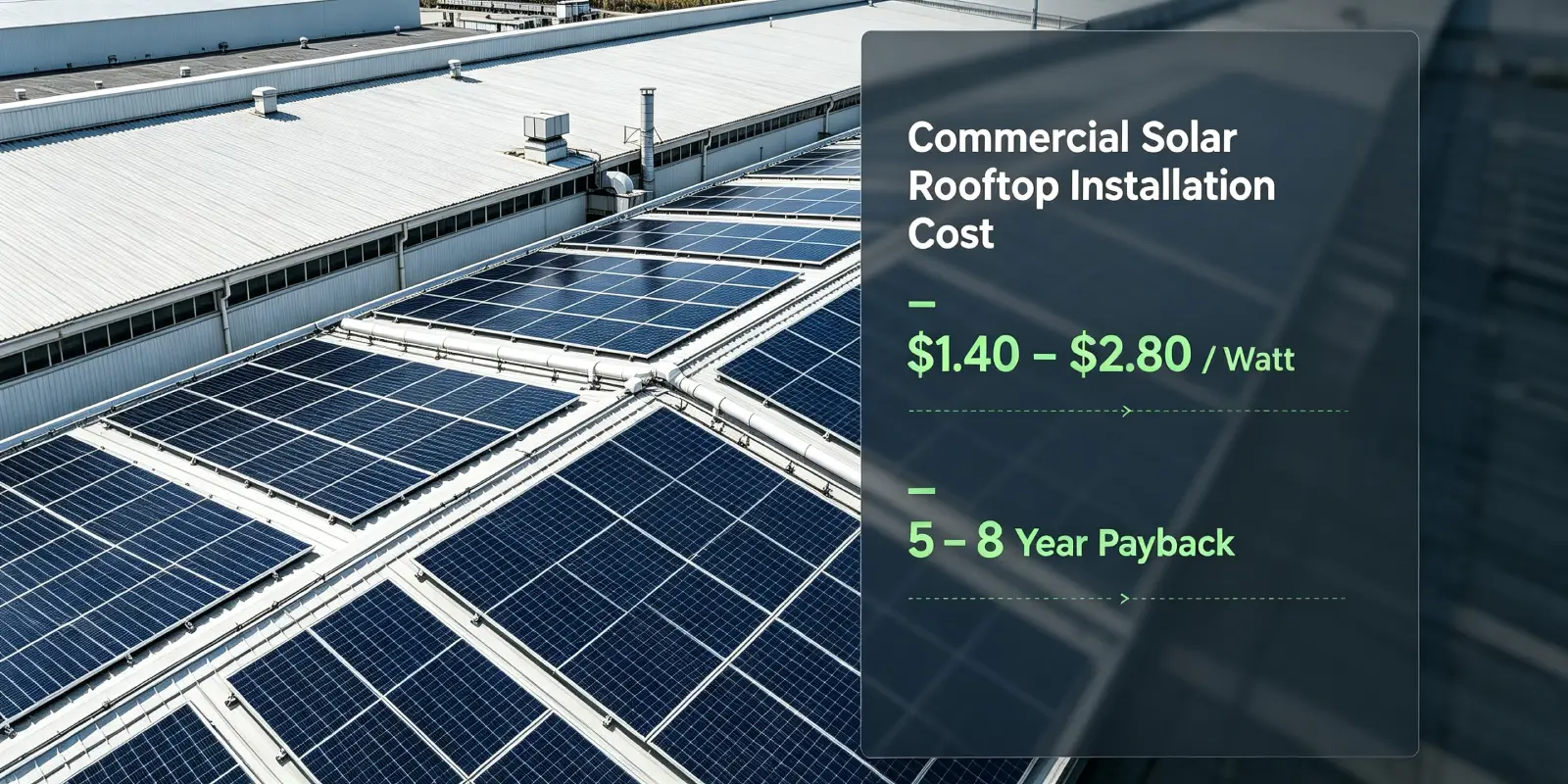
Summary: Written for factory, warehouse and office building owners, this guide breaks down the cost per watt for commercial rooftop solar in the US in 2026, total investment for different system sizes, key factors affecting quotes, ROI calculation logic, and the critical 30% ITC tax credit window. It also compares four financing options: cash purchase, loan, PPA and lease. Use this to quickly assess project feasibility and get accurate quotes.
A practical decision framework for factory owners, warehouse operators and facility managers. No fluff, just hard numbers, logic and actionable insights.
If you’re considering solar for your factory, warehouse, or office building, the first question on your mind is probably: “What does a commercial solar rooftop installation cost actually look like, and how many years until it pays for itself?”
This article answers exactly that.
What Does a Commercial Solar Rooftop Installation Cost in 2026?
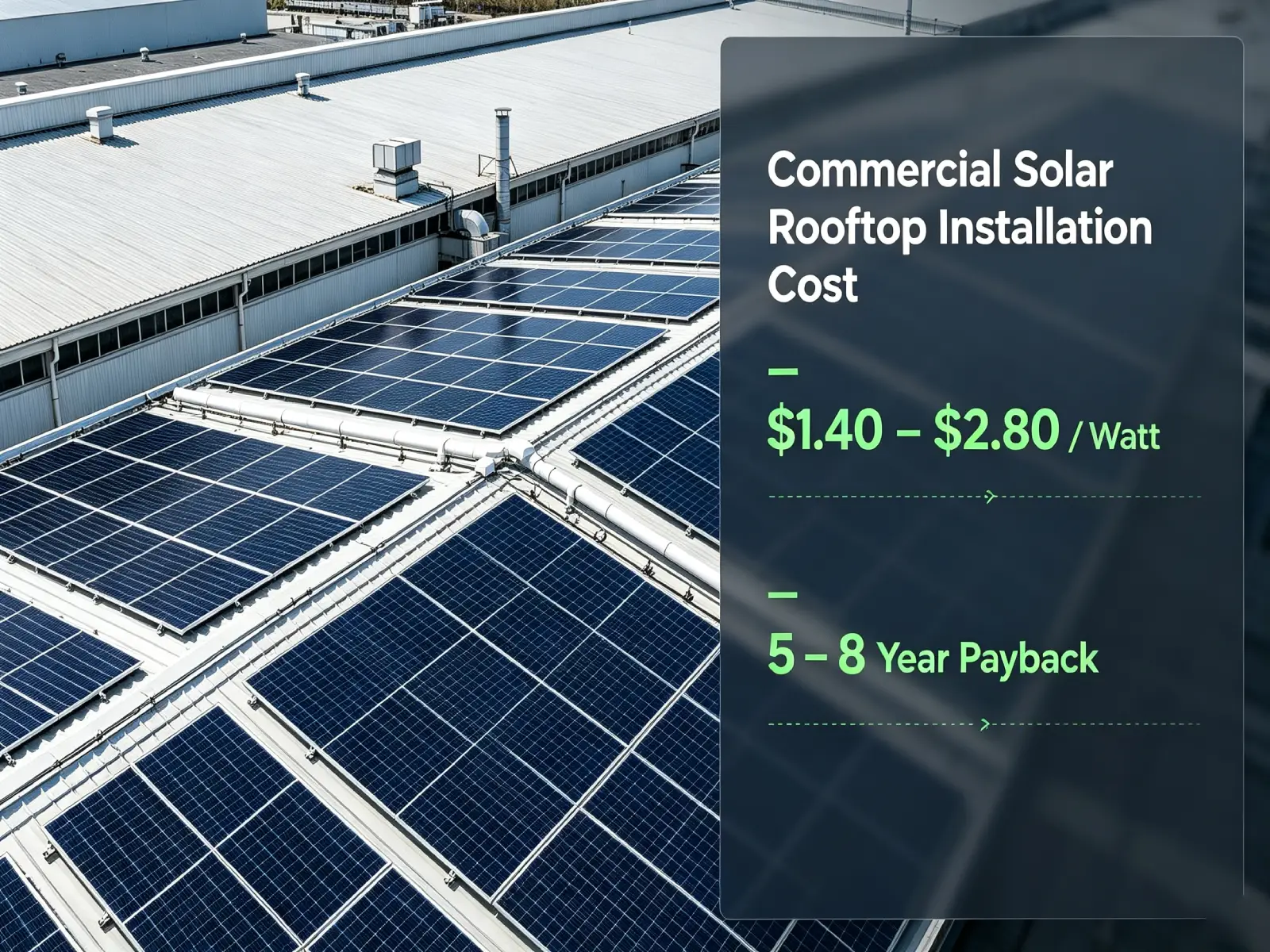
In 2026, commercial rooftop solar installation runs roughly $1.40 to $2.80 per watt, depending on system size.
Simply put:
The main rule: Bigger systems cost less per watt. A small 25 kW system might hit $2.80/W, while projects over 250 kW can drop to $1.80/W or lower. That’s economies of scale — bulk equipment discounts, spread-out labor costs, and one-time permit processing.
The global average wholesale commercial rooftop solar price in 2025 was around $1,000 per kW (or $1/W), but that’s just the factory wholesale price. The “installed cost” you pay covers engineering, procurement, construction, grid interconnection and commissioning, so it’s higher.
Why your quote looks different from others
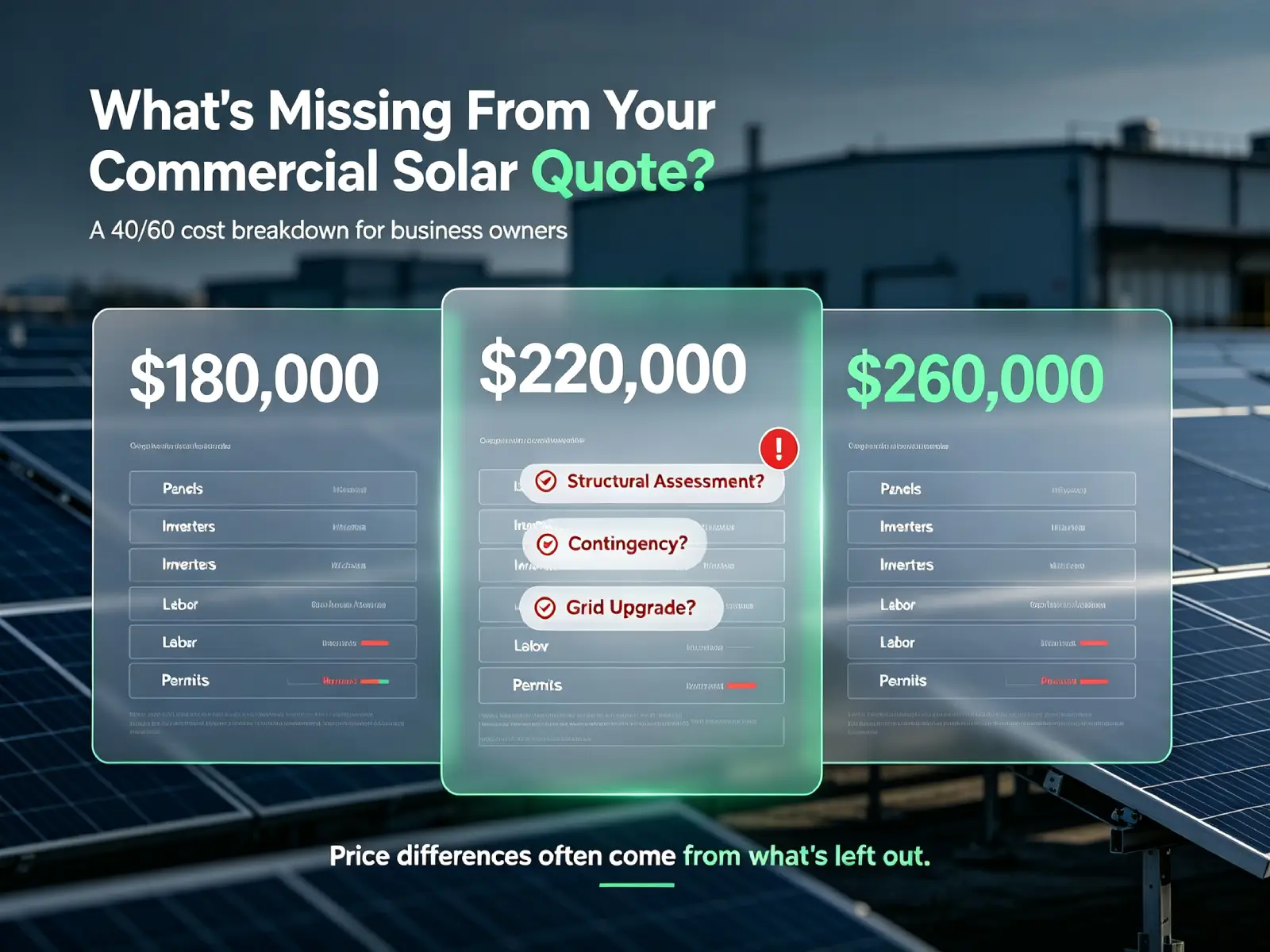
For the same 100 kW system, one contractor quotes $180k and another $280k. Where does that gap come from?
First, the condition of your roof. If your roof is nearing replacement, the smart move is to re-roof before adding solar. Otherwise, when you have to remove panels later for roof repairs, the tear-down and re-install fees will sting. Metal roofs and flat concrete roofs use different mounting methods; concrete may need ballast systems that add material costs.
Second, your electrical setup. Is there space in your electrical panel? Can your transformer handle the extra load? Will you need grid upgrade work? These hidden costs often get left out of preliminary quotes but will show up on your final bill.
Third, battery storage add-ons. Solar-only systems are the cheapest. Adding battery storage (like a 200kWh LFP bank) pushes up upfront investment, but it delivers extra value for sites with high demand charges or backup power needs — cold storage, data centers, production lines, for example.
Fourth, who builds it. A residential solar installer dipping their toes into commercial jobs works very differently from a dedicated C&I EPC contractor. Commercial projects carry stricter risk controls, compliance rules and insurance requirements.
Run the numbers: When do you break even?
The top concern for commercial buyers is payback period.
The typical target is 5 to 8 years for sites with decent electricity rates and heavy daytime power use. One industrial building study found a 40 kW system paid for itself in 8 years while cutting 285.6 tons of CO2 over its 25-year lifespan. A hotel solar study in Indonesia saw a 17.4 kW system hit payback in just 5.7 years, with an IRR of 20.25%.
Here’s the simple formula:
Payback years ≈ Net system cost ÷ Annual electricity savings
A 100 kW system in a moderately sunny region will generate roughly 150,000 to 190,000 kWh per year. If your commercial power rate is $0.15/kWh, that saves you $22,500 to $28,500 every year. With a net cost of $150,000 after ITC, payback lands around 5 to 7 years.
One big catch though: You need to use that power during the day. If most of the generated electricity gets sold back to the grid at a rate far lower than what you pay to buy power, your payback timeline stretches out. That’s why warehouses, manufacturing plants and cold storage facilities with high daytime consumption see the best economics.
Tax Credits: The biggest factor for 2026
If you’re based in the US, there’s a huge policy window open in 2026.
The 30% ITC (Investment Tax Credit) for commercial solar is still active under Section 48E. This is separate from the residential 25D credit, which expired at the end of 2025.
But time is limited. Under current rules, your project must be placed in service by December 31, 2027 to lock in that 30% credit. Projects signed in 2026 with a ready site and no major grid bottlenecks can realistically finish before 2027 wraps up. If you need roof replacement or face long grid interconnection queues, you’ll be cutting it close.
There’s also restored 100% bonus depreciation. Qualified commercial solar projects can deduct most of the system cost in the first year for tax purposes. Combined with the 30% ITC, you may recover 40% to 60% of total project costs in year one.
Two extra adders stack on top: Domestic Content Bonus (+10%) and Energy Community Bonus (+10%), which can push ITC all the way to 50%. Keep in mind these have strict compliance rules, so work through them carefully with your tax advisor.
Four ways to fund your project, very different outcomes
How you finance commercial solar directly impacts your cash flow and long-term gains.
Cash Purchase: You pay upfront in full, keep all tax benefits and all electricity savings. Highest long-term returns, fastest payback (usually 4-7 years), but requires available capital budget.
Loan: You own the system and keep the ITC, while paying in monthly installments. Great for businesses wanting the tax credit but preferring smoother cash flow. Watch out for dealer fees: some low advertised rates hide extra charges pushing effective interest to 4-8%.
PPA (Power Purchase Agreement): A third party owns the panels, you buy electricity by the kWh. $0 upfront cost, usually cheaper power than your utility. But the tax credits go to the developer, so your total long-term savings are lower. PPAs generally work best for 500kW+ projects; developers rarely take on smaller jobs.
Lease: Third party owns the system, you pay a fixed monthly fee. Unlike a PPA (where bills drop when production is low), leases charge the same fixed amount no matter how much power gets generated. Leases fit well for 50-250kW mid-size commercial sites.
Next step: Get your custom numbers
This article gives ranges and frameworks, not your final quote. To get precise figures, you need to:
Bring in an EPC for an on-site assessment. Any reputable contractor will inspect your site first before quoting — roof structure, electrical capacity, shading and grid connection. Run away from anyone giving you a precise price without visiting the property.
Clarify what’s included in the quote. Does it cover structural review? Who handles grid interconnection applications? Who manages commissioning and inspections? What does the maintenance contract cover? These items often get omitted from lowball bids and added later as change orders.
Don’t only shop for the lowest price. A quote 30% cheaper might use second-tier panels, skip performance guarantees, or come from an EPC firm that may not stay in business over the 25-year system lifespan. Commercial solar is a long-term asset, and picking the wrong partner costs far more than the money you save upfront.
Quick recap
For 100kW commercial rooftop solar in the US in 2026, net costs sit around $120k–$200k, with a 5–8 year payback. The 30% tax credit window closes at the end of 2027. Always complete an on-site assessment before locking in pricing.
About GTPOW | Gaotu Innovation
We’re your trusted solar solution provider. We offer customized commercial solar systems, OEM & ODM services, and end-to-end support for North American businesses. Reach out to discuss your rooftop solar project today.
Website: gtpowsolar.com
Related Posts
Development Trends of Outdoor Solar Products
From Standalone Power Generation to All-in-One Outdoor Living Energy Solutions In recent years, outdoor activities…
Best Rigid Solar Panels 2026 – Reviews & Ultimate Buying Guide
1. Introduction Looking for the best rigid solar panels 2026 for home rooftops, RVs, and…
The Best High Efficiency Solar Backpack for Hiking & Camping in 2026
If you love hiking, camping, or road-tripping in an RV, you’ve definitely run into two…
Leave a Reply