

Solar Power Knowledge
Tier 1 vs Tier 2 Solar Panels: What the Label Does and Does Not Tell You
 Gaotu Innovation
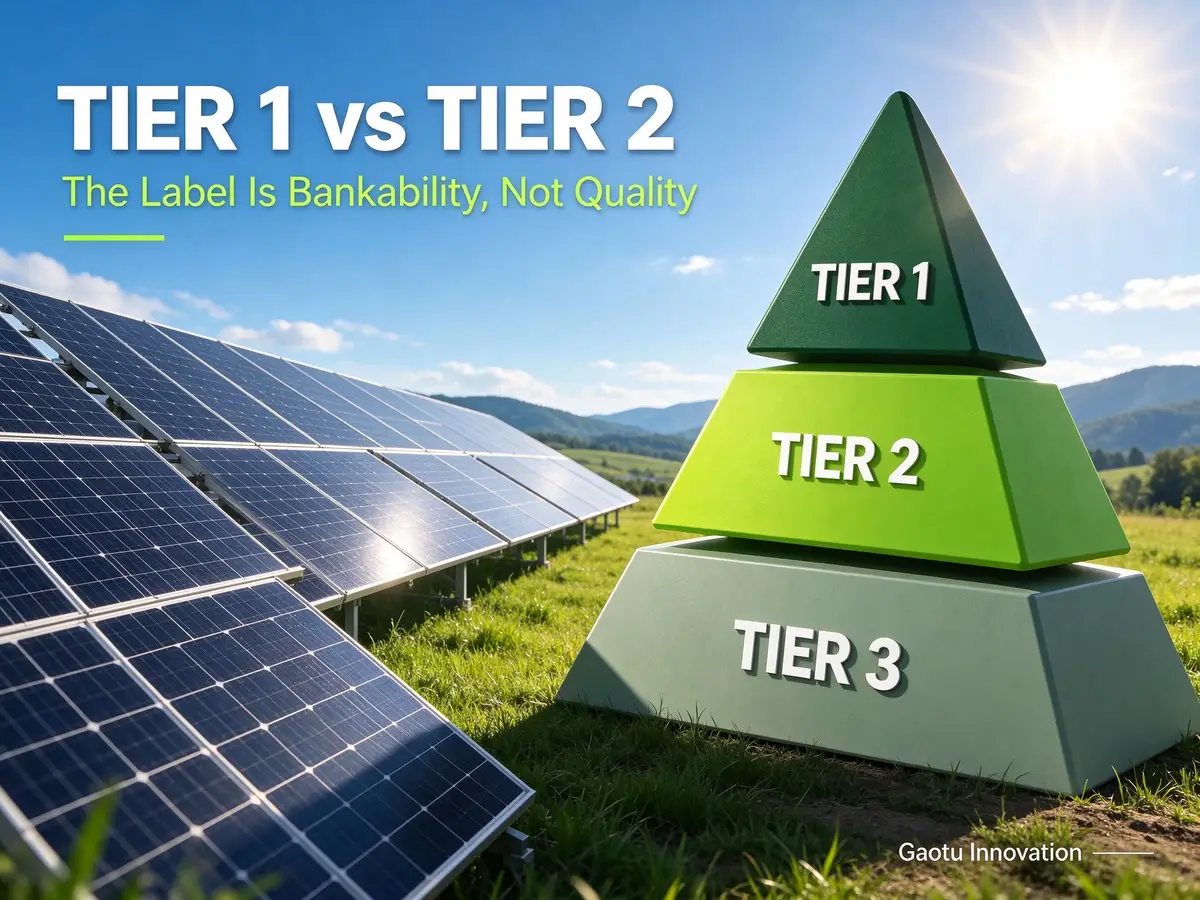
A distributor asks a supplier whether they are Tier 1. The supplier says yes and sends a badge. Nobody in that exchange has learned anything about the modules that will arrive in six weeks. Tier 1 is a bankability classification used to finance large projects — it is not a quality grade, not an efficiency rating, and not a statement about the cell grade inside the laminate. This article separates the three things buyers habitually conflate: the tier label, the cell grade, and the factory’s actual test records.
- Tier 1 is about bankability, not build quality. It reflects whether a manufacturer has supplied modules to a number of large projects financed on a non-recourse basis — a lender’s view of commercial durability.
- Grade A is about cells, not brands. It describes cosmetic and electrical binning inside the laminate, and it applies to any factory, Tier 1 or not.
- A Tier 1 brand can ship you Grade B cells in a value SKU, and a smaller manufacturer can ship you Grade A cells with a slimmer paper trail. The two labels answer different questions.
- For a residential reseller, the useful questions are returns rate, wattage consistency and warranty service — none of which the tier label measures.
Three Labels, Three Different Questions
| Label | Question it answers | Question it does not |
|---|---|---|
| Tier 1 / Tier 2 | Can this manufacturer’s product be financed on large projects? | Is the module in front of me built well? |
| Grade A / B / C cells | How consistent and defect-free is the cell batch? | Is the factory able to deliver and honour claims? |
| IEC / UL listing | Has this exact model, at this exact factory, passed the safety and performance tests? | Will the production run match the tested sample? |
All three matter, and none substitutes for another. A buyer who checks only the tier badge has verified the least interesting of the three for a residential order.
What Tier 1 Actually Measures
The tiering most buyers refer to comes from a commercial intelligence provider that classifies manufacturers by whether they have supplied modules to a defined number of large projects financed on a non-recourse basis, over a rolling window. The logic is lender-driven: if banks will lend against a project using these modules, the manufacturer is presumed commercially durable.
That yields a useful but narrow signal. It means the manufacturer is large enough to serve utility-scale projects, and that financiers accept the name. It does not mean:
- that every SKU from that factory uses Grade A cells;
- that the model you are buying is the model that was banked;
- that the factory will prioritise a 360 kW residential order against a 200 MW project;
- that the warranty claim service in your country is staffed.
The last point matters most to a reseller. A Tier 1 manufacturer with no local claims presence can be slower to resolve a six-module breakage than a mid-sized factory with a regional warehouse and an account manager who answers within a day. Tier is a financing concept; service is an operations concept.
Grade A, B and C Cells: The Distinction That Actually Reaches Your Roof
| Grade | What it means | Where it surfaces later |
|---|---|---|
| A | No visible defect, tight electrical binning, consistent appearance | Predictable string behaviour; low cosmetic complaints |
| B | Minor cosmetic deviation, sometimes lower power class, often mixed binning | Visible patchwork on a roof; mismatched strings; more installer callbacks |
| C / off-spec | Electrical or structural defects, micro-cracks, no reliable traceability | Early power loss, hot spots, claims you cannot administer |
Grade is normally invisible from the outside once laminated. That is precisely why it is the easiest place to cut cost and the hardest place for a buyer to detect — which loops back to the price question. If a quote sits well below comparable offers, the answer is usually cell grade rather than factory efficiency. Our article on what drives a per-watt price walks through the same logic from the cost side.
How to Verify a Factory Without Relying on the Badge
- Ask for the flash-test file for the exact batch. Not a datasheet range, not a sample report — the per-module serial and measured wattage for the production lot you are buying.
- Ask for EL images from the same lot. Electroluminescence reveals micro-cracks, soldering defects and cell mismatch that no label will show you.
- Match the certificate to the model and factory. A listing valid for a sister model, or for a different production site, is not your listing. The verification steps are set out in our EU and US certification guide.
- Ask for a production video walk-through. Lay-up, lamination, framing, EL station, flash tester — a factory that cannot show these is not a factory you can audit remotely.
- Ask for two references in your market, at your order size. A utility-scale reference tells you the factory is big; a 300 kW residential reference tells you the factory is usable.
- Confirm the claims path in writing. Who decides, who ships, who pays freight. This is the operational half of the warranty, covered in the warranty terms guide.
What a Residential Reseller Should Actually Care About
Tier labels are designed for the concerns of a 200 MW project: bank financing, insurance, completion guarantees. A residential distributor’s concerns are different, and four of them dominate:
- Returns rate. How many modules per hundred come back, and for what reason. Ask for the figure, not the adjective.
- Wattage consistency. Whether the delivered flash data clusters tightly or spreads across the tolerance band, because installer callbacks start when a string underperforms.
- Spare-part availability. Whether the factory can ship a matching module from stock two years later, when a customer needs one replacement on a roof of fifty.
- Claim responsiveness. The number of days from a filed claim to a decision. A slow yes costs more than a fast no.
This is why the supplier evaluation in our supplier selection guide is built around evidence rather than reputation. Reputation gets a supplier onto a shortlist; evidence gets them the order.
Red Flags in Tier Claims
- A “Tier 1 certificate” PDF. Tiering is a periodic classification, not a certificate issued to a buyer. Anyone presenting a document as proof is misrepresenting the scheme.
- Tier claim plus vague model. If the badge is offered but the exact model, factory and listing are not, the badge is decoration.
- Very low price with a Tier 1 story. The two rarely coexist on the same specification. One of them is being stretched.
- No answer on cell supplier. A supplier who cannot name the cell source is not in control of its own bill of materials.
- References only at utility scale. It signals the factory is built for projects, not for repeatable residential distribution.
Frequently Asked Questions
Are Tier 1 solar panels better quality?
Not automatically. The tier reflects bankability and scale, not cell grade or process control. A Tier 1 manufacturer can still ship a value SKU built on lower-grade cells.
Is a Tier 2 panel unsafe or uncertified?
No. Tier 2 usually means the manufacturer has not met the project-finance threshold. Certification is a separate matter and can be perfectly valid for your market.
How can I tell if a module uses Grade A cells?
Ask for flash-test data and EL images from the specific lot, plus the cell supplier and binning rule in writing. Appearance alone will not tell you, because grading happens before lamination.
Does Tier 1 matter for a small residential order?
Much less than service, spare-part availability and wattage consistency. Tier is a financing signal; your business runs on repeat orders and claims handling.
Can a factory be Tier 1 and still fail an audit?
Yes. Tiering does not audit process control, packing standards or claim response. A factory audit and a customer reference check answer the questions the tier label leaves open.
Want the evidence pack instead of the badge? Send your target market and volume — our team will return flash data, EL samples, listings and two references at your order size. Talk to the GTPOW team.
Related Posts
How to Install Solar Panels on a Motorhome: A Step-by-Step Guide
If you’ve ever lain awake in bed listening to the endless drone of a noisy…
Rigid vs Flexible Solar Panels
More people across the US and Europe are switching to solar power for homes, RVs,…

How Much Does an RV Solar System Cost in 2026?
Article Summary If you’re curious about RV solar system pricing in 2026, this guide breaks…


Leave a Reply