

Solar Power Knowledge
TOPCon vs PERC for Commercial Rooftops: Which One Actually Makes Sense in 2026
 gaotu
gaotu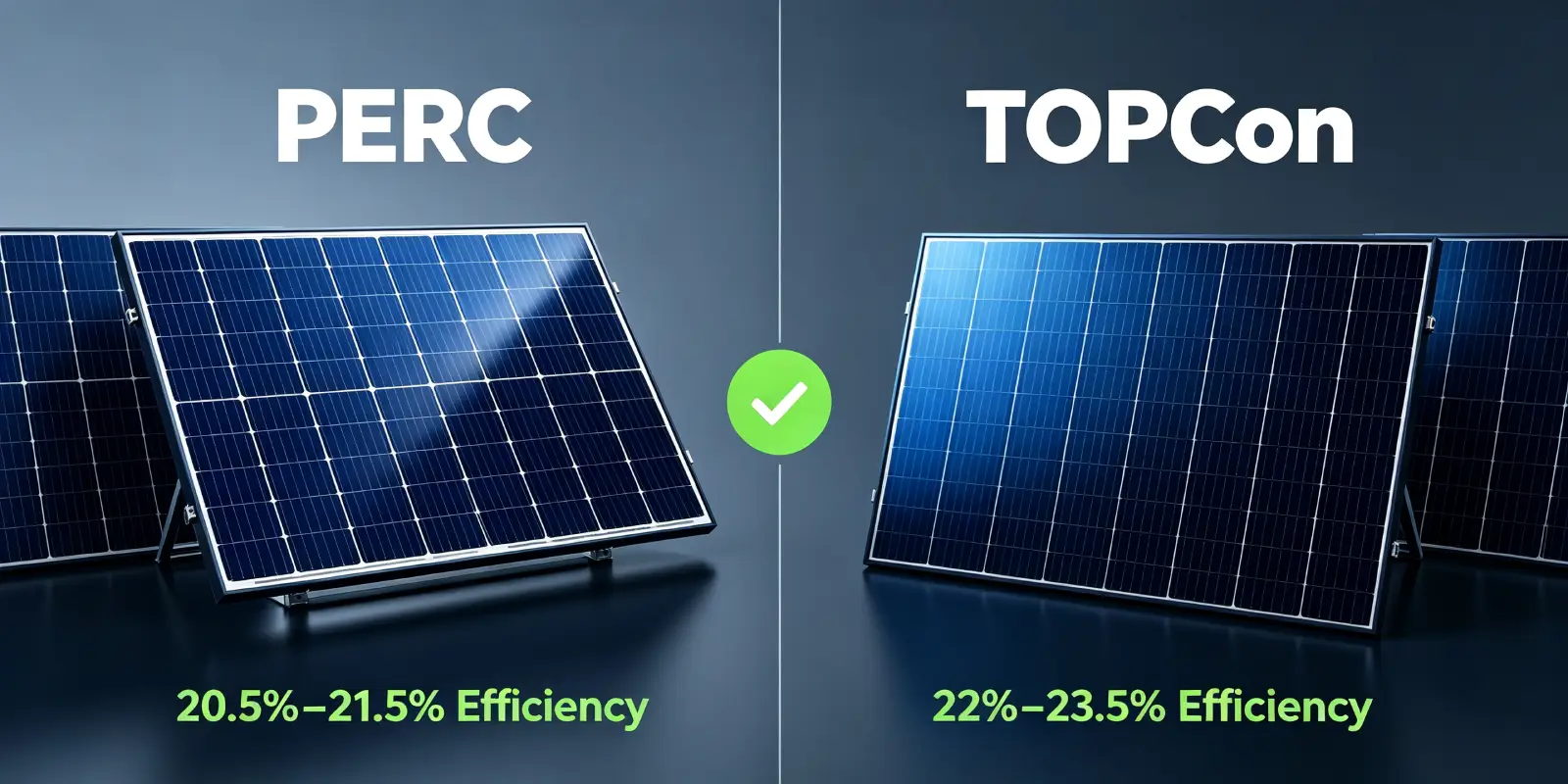
You ask what that means. He says higher efficiency, lower degradation, better temperature coefficient. You nod, but you’re thinking: So what? For my roof, what does that actually change?
This article skips the jargon. It tells you what actually matters for commercial rooftops—and which one you should pick.
Quick Answer: Which One Should You Choose in 2026?
Go with TOPCon. Not because it’s “more advanced,” but because:
- The price gap is gone. In 2026, TOPCon modules and PERC modules are within $0.01–$0.02 per watt of each other. In some markets, TOPCon is actually cheaper because PERC production lines are being phased out.
- Same roof area, 3%–5% more power. Commercial roof space is limited. This is real money. A 500kW system with TOPCon can fit 15–25kW more capacity than PERC.
- Lower degradation. TOPCon degrades about 1% in year one, then 0.4% per year after. PERC degrades 2% in year one, then 0.45% per year. Over 25 years, that’s a 2%–3% difference in cumulative generation.
- Better temperature coefficient. TOPCon runs around -0.30%/°C; PERC runs around -0.35%/°C. In hot climates, that difference compounds.
One caveat: make sure you’re buying real TOPCon, not a PERC module with a TOPCon label. In 2026, some suppliers are slapping TOPCon stickers on tweaked PERC lines. Look for third-party test reports, not marketing brochures.
Why This Choice Matters More on Commercial Rooftops
Residential rooftops and commercial rooftops have different selection logic.
Residential roofs have limited space, but homeowners usually install once and care more about “can I fit it” than “what’s the cost per watt.” Commercial roofs have a different problem: roof area is money. Your roof is a fixed size, and how many kilowatts you can fit directly determines how much you save on electricity.
On the same roof, TOPCon can fit 3%–5% more capacity than PERC. That means tens of thousands more kilowatt-hours per year. At a commercial rate of $0.15/kWh, a 500kW system with TOPCon saves $3,000–$5,000 more per year than PERC. Over 25 years, that’s $75,000–$125,000.
That’s not pocket change. That’s why commercial projects are shifting to TOPCon.
Differences Beyond the Module Itself
Module selection isn’t just about the panel. It’s about how it performs in the system.
Temperature coefficient. TOPCon has a better temperature coefficient, meaning less power loss at high heat. In Guangdong or the Middle East, module surface temperatures can exceed 65°C in summer. PERC loses 1.5%–2% more power than TOPCon. In hot climates, that difference accumulates across the year.
Bifaciality. On flat roofs—the most common commercial scenario—modules can be bifacial, capturing reflected light on the back side. TOPCon bifaciality is typically 80%–85%; PERC is around 70%–75%. On light-colored roofs, bifacial gain can reach 5%–10%. PERC can’t hit that.
Low-light performance. TOPCon responds better in early morning, late afternoon, and overcast conditions. For commercial roofs, this means more stable generation that better matches your daytime load profile.
Degradation and warranty. TOPCon linear degradation warranties typically run 30 years; PERC is 25. For a commercial asset, five extra years of warranty is real value.
A Real Cost Comparison
Let’s put the TOPCon vs PERC difference into real numbers. Take a 500kW commercial rooftop project:
Spend $5,000 more, save $105,000 more over 25 years. This isn’t “either one works.” This is a clear financial decision.
When PERC Still Makes Sense
There are two situations where PERC is still reasonable:
First, extremely tight budget with a short project horizon. If you’re building a temporary structure, or you plan to hold the asset for only 5–7 years and sell, PERC’s lower upfront cost might pencil out. But note: residual value for used PERC modules is dropping fast.
Second, a supplier has excess PERC inventory and offers a significant discount. If PERC is $0.03/W cheaper or more, and your roof area is ample, and it’s not a bifacial scenario, PERC can work. But this situation is becoming rarer in 2026.
How to Verify You’re Getting Real TOPCon
There’s plenty of “TOPCon concept” PERC on the market. Check three things:
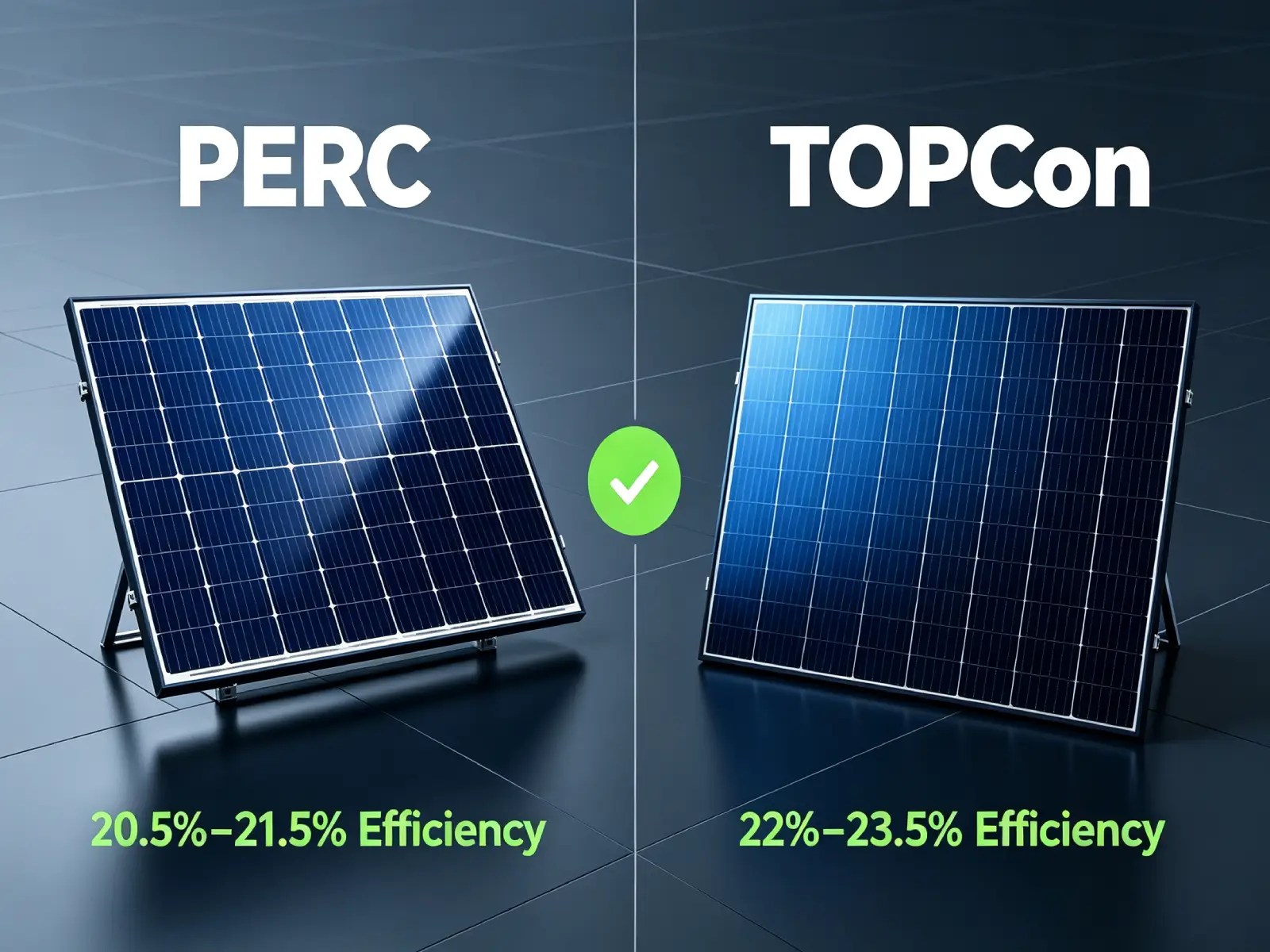
First, third-party test reports. Ask for IEC 61215 and IEC 61730 test reports, plus third-party lab efficiency tests. TOPCon efficiency is typically 22%–23.5%; PERC is 20.5%–21.5%. If the claimed efficiency is over 22% but the price matches PERC, be suspicious.
Second, temperature coefficient. TOPCon’s temperature coefficient is between -0.29% and -0.32%/°C. PERC is between -0.34% and -0.37%/°C. Check the datasheet for the exact number.
Third, bifaciality. If a supplier claims over 80% bifaciality but the temperature coefficient looks like PERC, they’re playing with words.
The Bottom Line
In 2026, TOPCon is the default answer for commercial rooftops. The price gap is gone, it generates 3%–5% more power on the same area, has a better temperature coefficient, higher bifaciality, and a longer warranty.
PERC only makes sense in rare cases: extremely tight budget, short project horizon, or a significant discount from a supplier with excess inventory.
But for most commercial projects, this isn’t a question of “should I spend more.” It’s a question of “why would I choose worse technology for the same money?”
If you’re comparing specific models, send me your roof area, location, and electricity consumption, and I can calculate the actual difference between TOPCon and PERC for your project.
Quick recap
For most commercial rooftops in 2026, TOPCon wins on power density, temperature performance and warranty—for roughly the same price as PERC. Verify with third-party test reports before you buy.
About GTPOW | Gaotu Innovation
We’re your trusted solar solution provider. We offer customized commercial solar systems, OEM & ODM services, and end-to-end support for North American businesses. Reach out to discuss your rooftop solar project today.
Website: gtpowsolar.com
Related Posts
How to Order OEM & ODM Portable Solar Panels: Complete Sourcing Checklist
Executive Summary: Sourcing off‑grid solar products involves far more than just solar cell efficiency. For…
Solar Panel Supplier Evaluation Framework: On-Time Delivery, Response Time, Reorder Rate
Core Summary Most buyers pick a solar panel supplier based on price, catalog, or how…

How to Find Reliable Flexible Solar Panel Wholesale Supplier
Flexible solar panels have become one of the fastest-growing renewable energy products for off-grid applications,…



Leave a Reply